Quick verdict
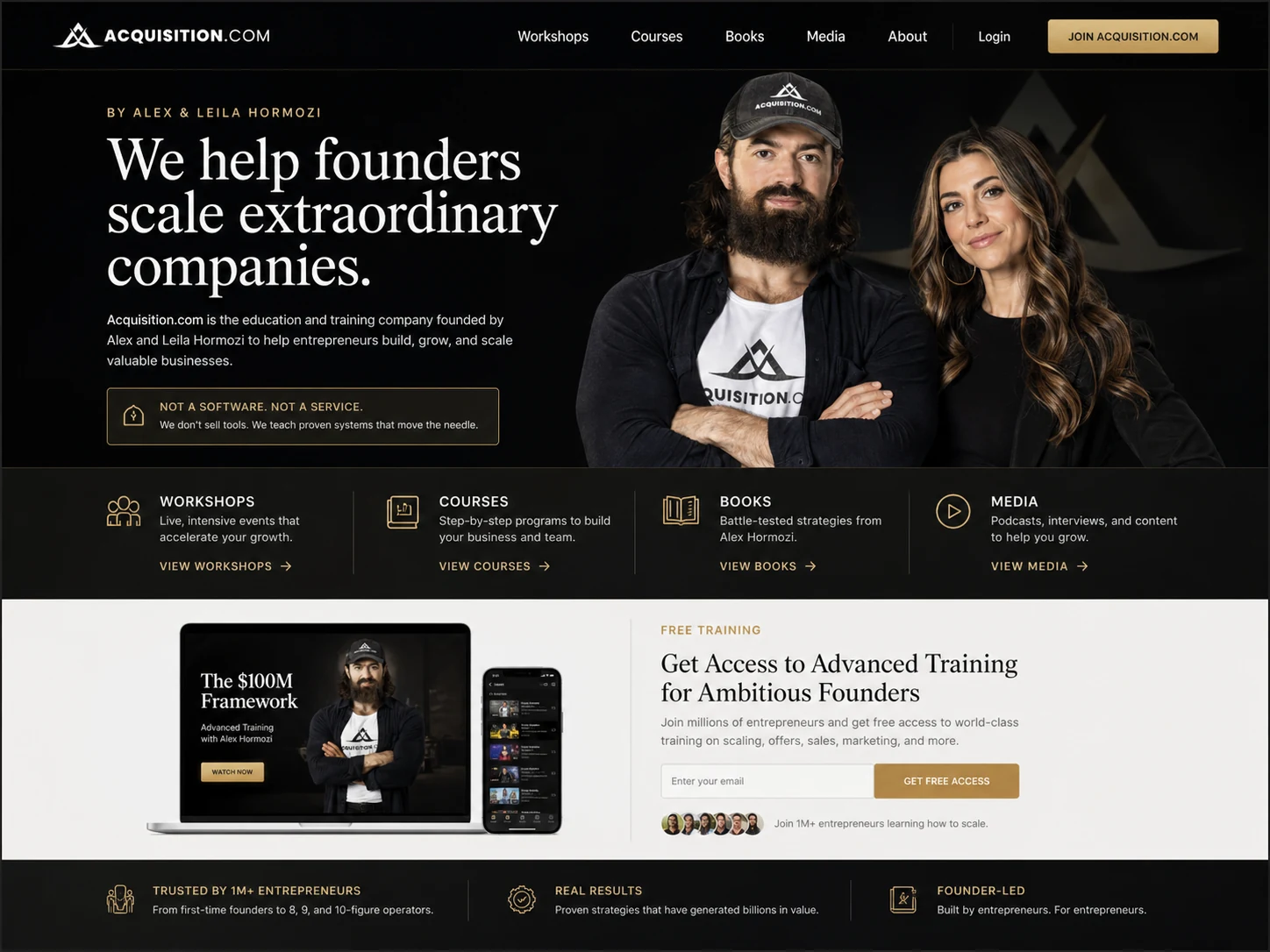
Acquisition.com is worth taking seriously, but I would not treat it like a normal online course checkout.
That is the first decision point.
The public brand has a wide free education path: courses, videos, books, a personalized scaling roadmap, and founder-led business content around offers, leads, money models, hiring, profit, and strategy. That part is low-risk. Use it first. The higher-stakes decision is the paid workshop route, because the public workshop page positions it as a serious in-person business education experience, not a casual digital download.
For my money, Acquisition.com makes the most sense for active founders who already have revenue, a clear constraint, and enough implementation capacity to turn advice into action after the event. It is much weaker for beginners who are still trying to choose an idea, validate demand, or buy motivation.
The brand authority is real enough to pay attention to. But brand authority is not the same thing as buyer fit.
The main strength is the practical business education ecosystem. The main risk is paying for a high-ticket workshop before the free material has already helped you diagnose a real business bottleneck. Before booking anything, I would check the current event price, qualification rules, refund and transfer terms, travel cost, and whether your business is actually at the stage the workshop is built to serve.
Next step: Start with the lowest-risk buyer path. Review the current Acquisition.com route only after the free material and workshop fit both make sense.
Review snapshot
| Review point | Practical take |
|---|---|
| Best for | Active founders, operators, and business owners with a real scaling constraint |
| Not ideal for | Beginners, casual course buyers, or people looking for a simple SaaS subscription |
| Main use case | Using free education and roadmap tools before deciding whether a paid workshop fits |
| Free path | Free training, free courses, and a personalized scaling roadmap |
| Paid path | Public workshop route, book shop, and qualification-led business education paths |
| Pricing note | Free education starts at $0; public workshop pages have shown a $5,000 per-seat route that should be verified live |
| Main strength | Practical founder education around offers, leads, people, profit, and strategy |
| Main concern | High-ticket event fit, strict refund language, travel cost, and implementation capacity |
| Nearby routes | Amazing Selling Machine, One Funnel Away Challenge, Vince Ecom Mastery, Funnel Builder Secrets-style offers |
| Best next step | Use the free roadmap and courses before evaluating a paid workshop |
What is Acquisition.com?
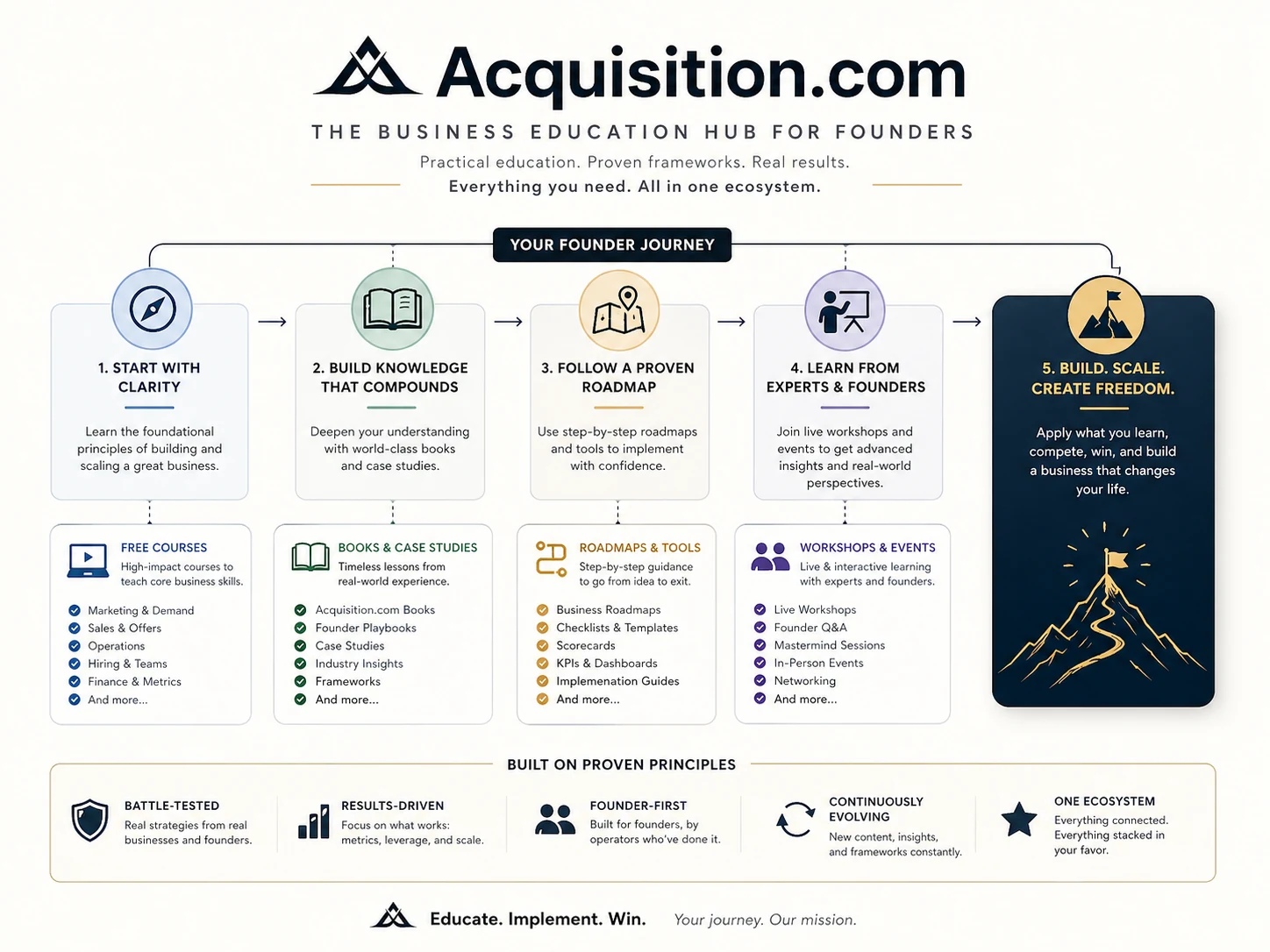
Acquisition.com is best understood as a business education and founder scaling ecosystem, not a software product.
That sounds obvious, but it changes the review.
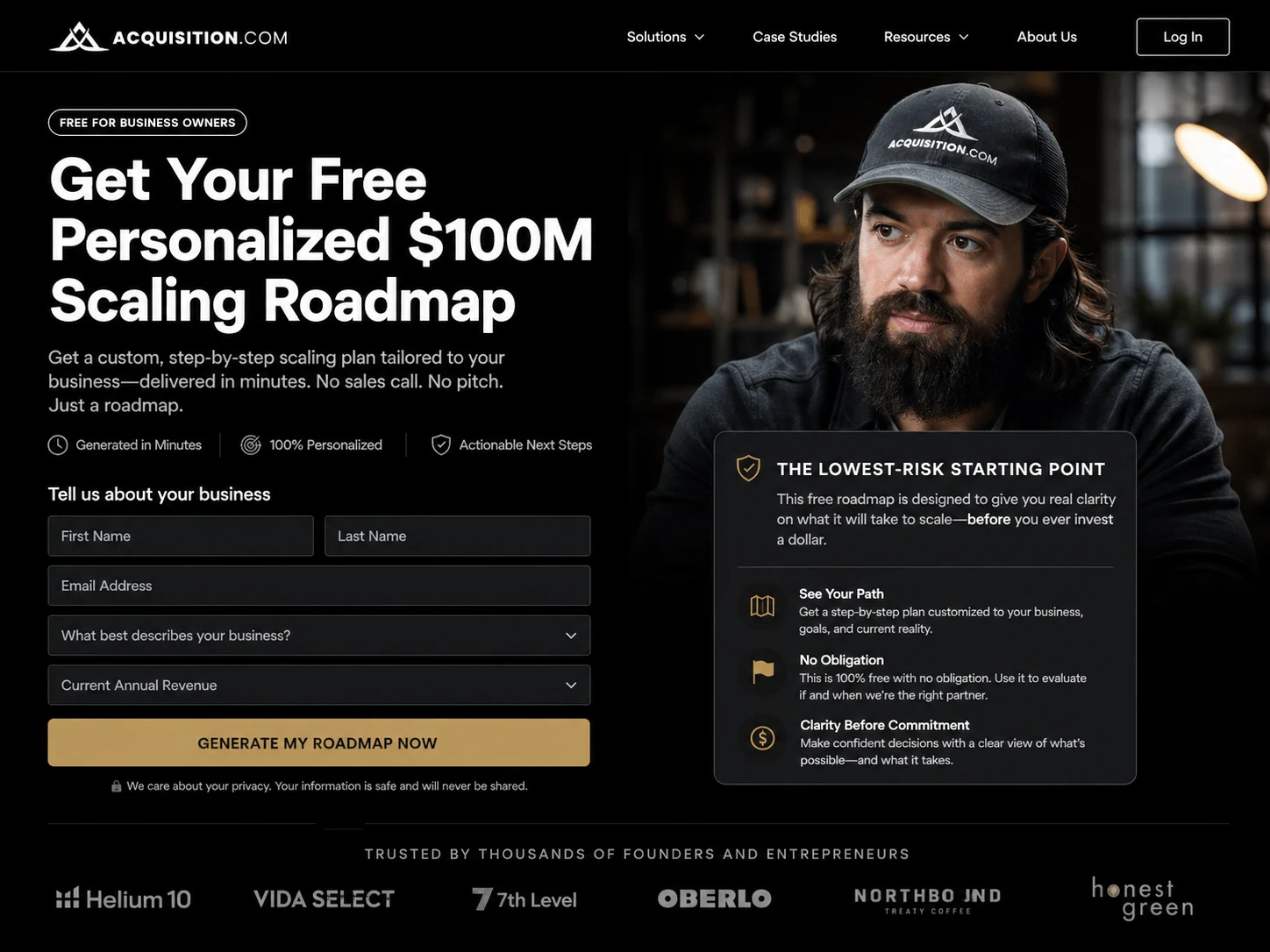
There is no dashboard to compare, no monthly seat limit to calculate, and no simple “free trial versus paid plan” decision. The public buyer path moves through free training, free courses, books, the personalized $100M Scaling Roadmap, workshop pages, qualification calls, media, and broader firm-level routes. A buyer can enter at several points, and those points do not carry the same cost or risk.
The homepage positions Acquisition.com around scaling a business, with free advanced training and courses such as money models, offer creation, lead generation, and scaling. The workshop path is positioned as hands-on, tactical, and business-stage dependent, with subject matter experts and direct help around business constraints.
Our review approach compares public product pages, pricing details, event terms, refund language, buyer workflow fit, and nearby business education alternatives. I would not treat a famous founder, a free course, or a workshop testimonial as enough proof that the paid route fits your business.
The common misunderstanding is thinking Acquisition.com is one product.
It is not. It is a brand ecosystem. For some buyers, the free content may be enough for months. For others, books may be the right middle step. For qualified founders with a specific scaling constraint, the workshop may be worth evaluating. The danger is skipping those steps and jumping straight to the most expensive path because the brand feels credible.
Who should use Acquisition.com?
Acquisition.com is most useful for founders who already know they have a business problem, not just an ambition problem.
Active business owners with offer or lead-generation constraints are the clearest fit. If you already sell something, have customer demand, and know that the bottleneck is positioning, conversion, pipeline, or sales process, the free courses and roadmap can give you a structured way to think before you pay for anything.
Operators with a growing team may also benefit. Acquisition.com’s public workshop language leans into topics such as hiring, profit, management, decision-making, and strategy. That is more useful when you already have enough moving parts for those issues to be real.
Founders who already follow Alex and Leila Hormozi may find the ecosystem easier to evaluate. If you know the frameworks, have read the books, and have used the free material, you are in a better position to decide whether the workshop is a logical next step rather than a brand-driven impulse.
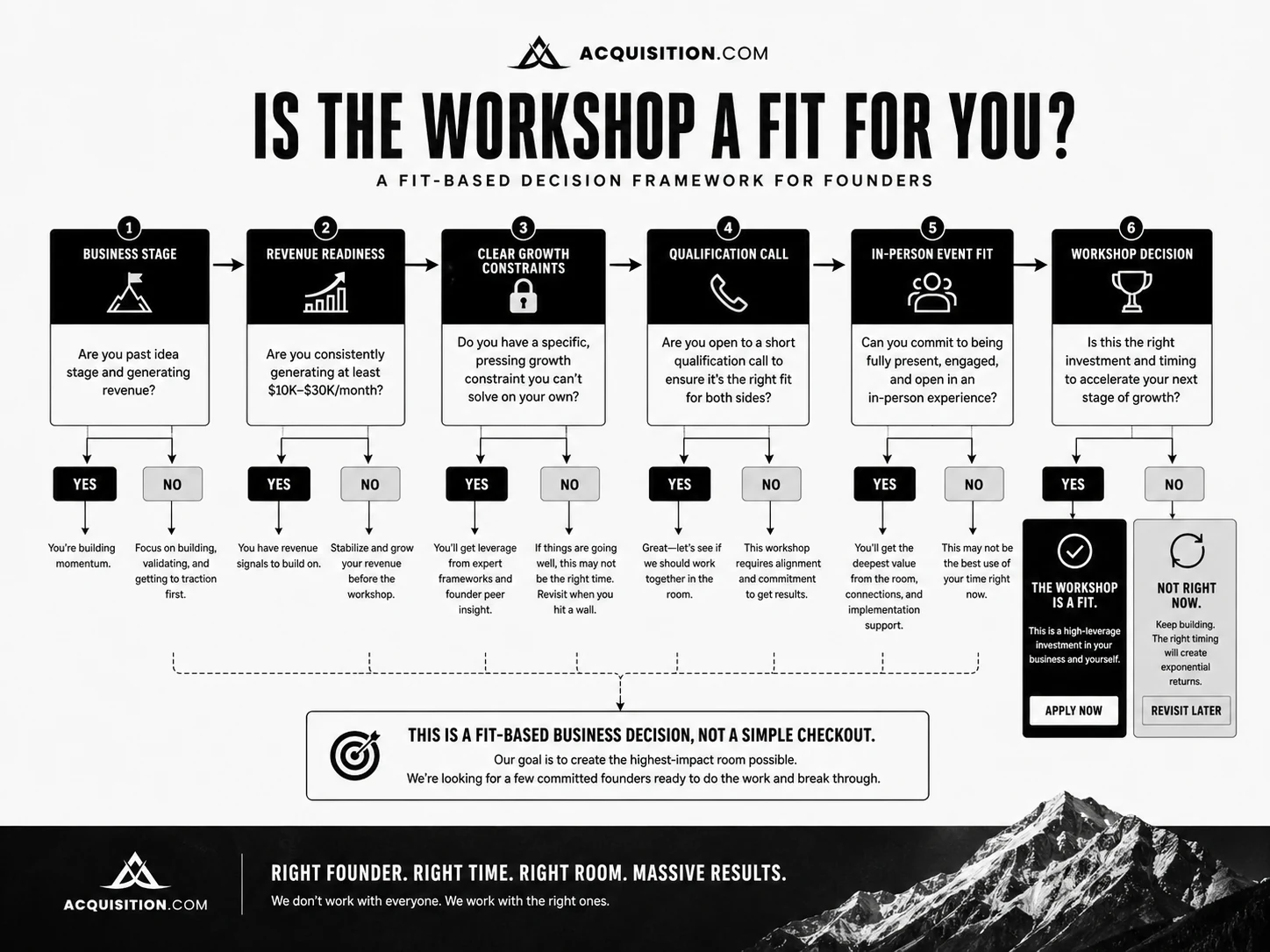
The paid workshop route is most believable when three things are true: your business has meaningful traction, your constraint is specific, and you can implement after the event. Without those three conditions, even a strong workshop can become expensive inspiration.
Who should avoid Acquisition.com?
Beginners should be careful.
If you have not validated demand, made consistent sales, or identified a real constraint, the free material is probably the better first step. A high-ticket workshop cannot replace market proof.
Buyers looking for a standard self-serve course subscription should also slow down. Acquisition.com has free content and shop products, but the workshop route is qualification-based and event-driven. That is a different buying experience from joining a course library and canceling next month.
I would also be cautious if you are buying mainly because of a coupon search. Acquisition.com is not a normal coupon-code store. The practical savings path is using the free courses, roadmap, and book-level material before considering a paid seat.
Founders with tight cash flow should be especially careful. A workshop ticket is not the only cost. Travel, lodging, time away from the business, follow-up implementation, and refund exposure all matter. If paying for the workshop creates financial pressure before you have squeezed value out of the free material, that is a signal to wait.
Finally, avoid treating the brand as a shortcut to guaranteed outcomes. The official pages include results disclaimers, and that is appropriate. Education can help, but it does not remove the work, market conditions, execution quality, or business-specific constraints.
How Acquisition.com fits into a real workflow
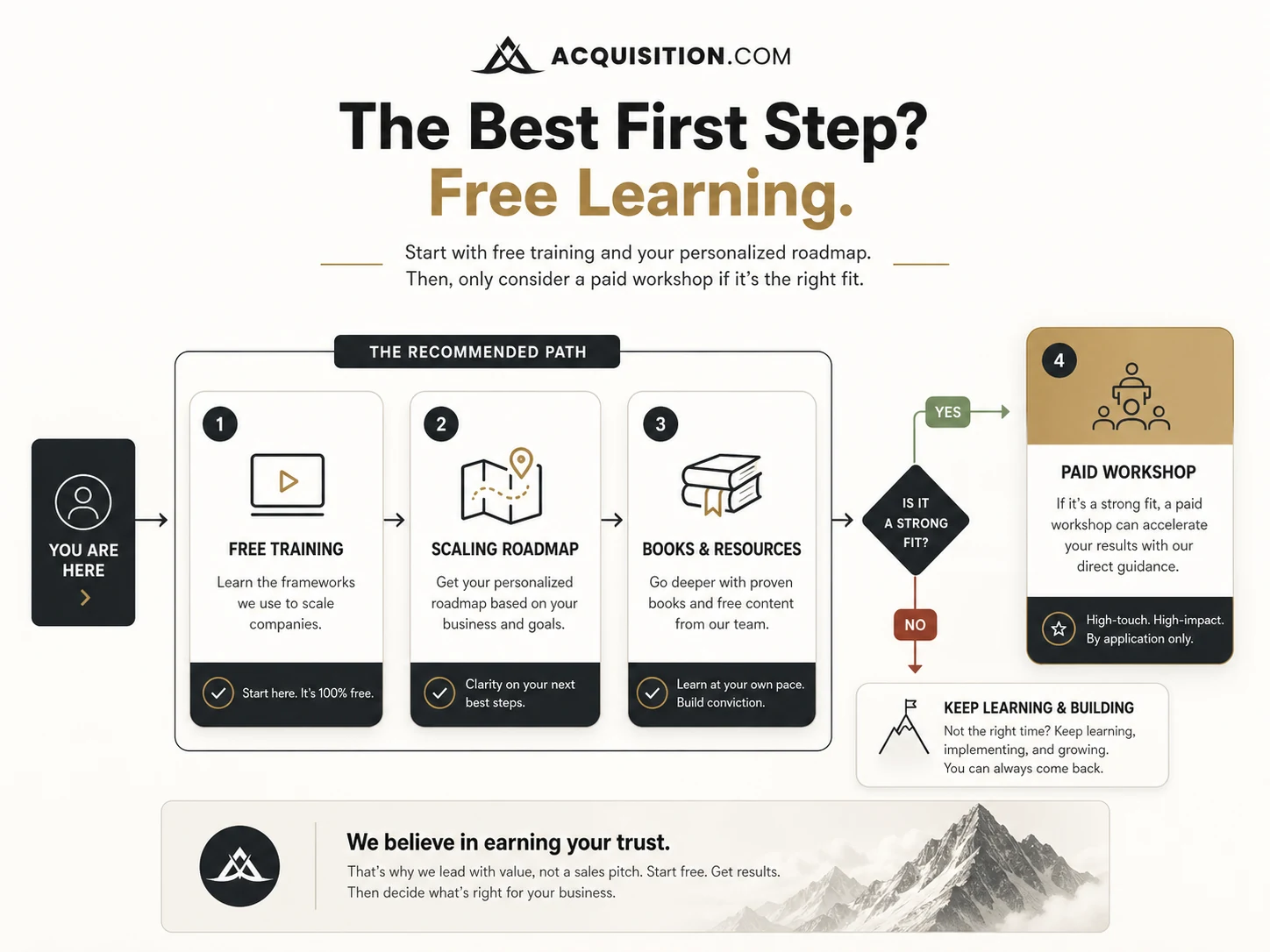
A good Acquisition.com workflow starts free.
The wrong workflow is: watch a few clips, feel motivated, click the paid workshop page, and hope proximity to the brand creates business growth.
A better workflow looks like this:
- Pick one current business constraint.
- Use the free roadmap or a relevant course to diagnose that constraint.
- Apply one framework to your actual offer, lead flow, hiring process, profit model, or strategy.
- Measure whether the advice changes a real business decision.
- Read the books or lower-cost material if you need more framework depth.
- Only then evaluate whether a workshop, qualification call, or paid path makes sense.
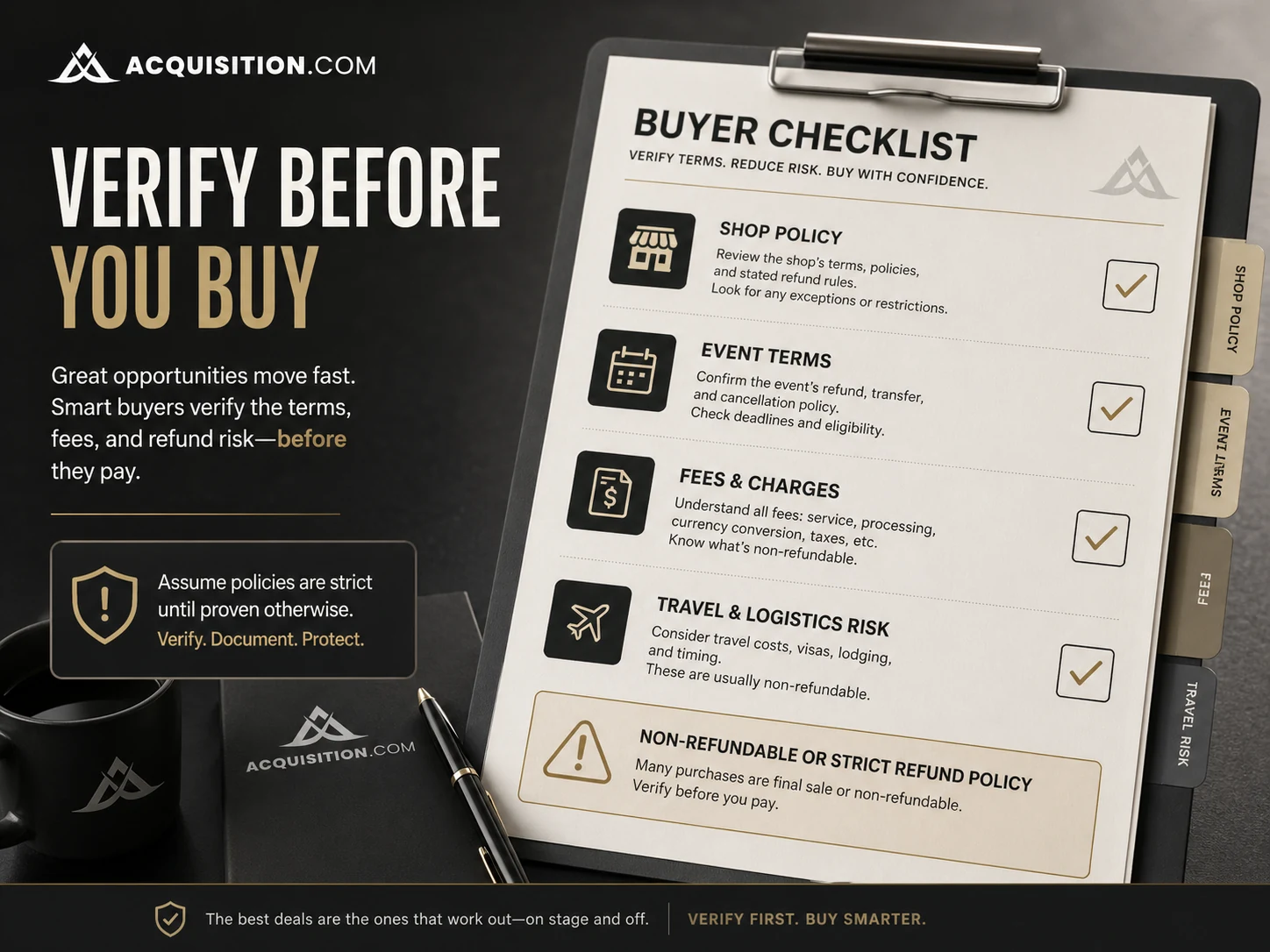
- Before paying, verify current price, terms, event logistics, and refund rules.
That sequence protects the buyer.
Acquisition.com becomes more useful when it is part of an implementation loop: learn, apply, measure, adjust, then decide whether deeper access is worth the cost. It becomes weaker when it is used as motivational content without a clear next action.
Real-world buyer scenarios
The founder with messy lead flow
This buyer has a real product, real customers, and a frustrating acquisition problem. They are not asking, “How do I get inspired?” They are asking, “Why is my pipeline inconsistent?”
Acquisition.com may fit if the free lead generation and offer content helps the founder identify a specific fix. The workshop may become worth evaluating if the business is already large enough for tactical feedback to matter.
The risk is buying too early. If the founder has not applied the free material yet, the workshop becomes a hope purchase.
The operator stuck between growth and hiring
This buyer has revenue but keeps hitting people, process, and management constraints. Acquisition.com’s broader scaling language may fit better here than a narrow funnel course.
The key check is whether the buyer can bring a specific operational problem into the workshop or qualification process. A vague “I want to grow” is not enough. A specific “our sales team cannot convert enough booked calls” or “I cannot delegate delivery without quality dropping” is more useful.
The beginner attracted to the Hormozi brand
This buyer may get value from the books, free courses, and roadmap. That is the right starting point.
I would not push this buyer toward a high-ticket event. At the beginner stage, the better question is whether the free material helps them build a real offer, talk to customers, and make first sales. If not, a workshop will not fix the missing foundation.
The ecommerce or funnel-focused buyer
Some buyers may not need a broad founder scaling ecosystem. They may need a more focused route: Amazon FBA education, funnel-building training, ecommerce execution, or offer mechanics.
That is where nearby DealBestDaily routes can make more sense. Acquisition.com is broader. A narrower course can be better when the buyer already knows the exact channel they want to improve.
Key features that actually matter
Free advanced training
The free training path is the safest part of the Acquisition.com ecosystem. It lets buyers sample the teaching style, frameworks, and level of tactical detail before making a paid decision.
Buyer note: If the free courses do not produce useful action in your business, do not assume the paid workshop will automatically fix that.
Personalized scaling roadmap
The roadmap is useful because it gives buyers a low-risk way to identify where they may be stuck. A diagnostic tool is better than jumping straight into a paid path.
Buyer note: Treat the roadmap as a starting point, not a final strategy. The quality of the next step still depends on execution.
Books and lower-cost framework study
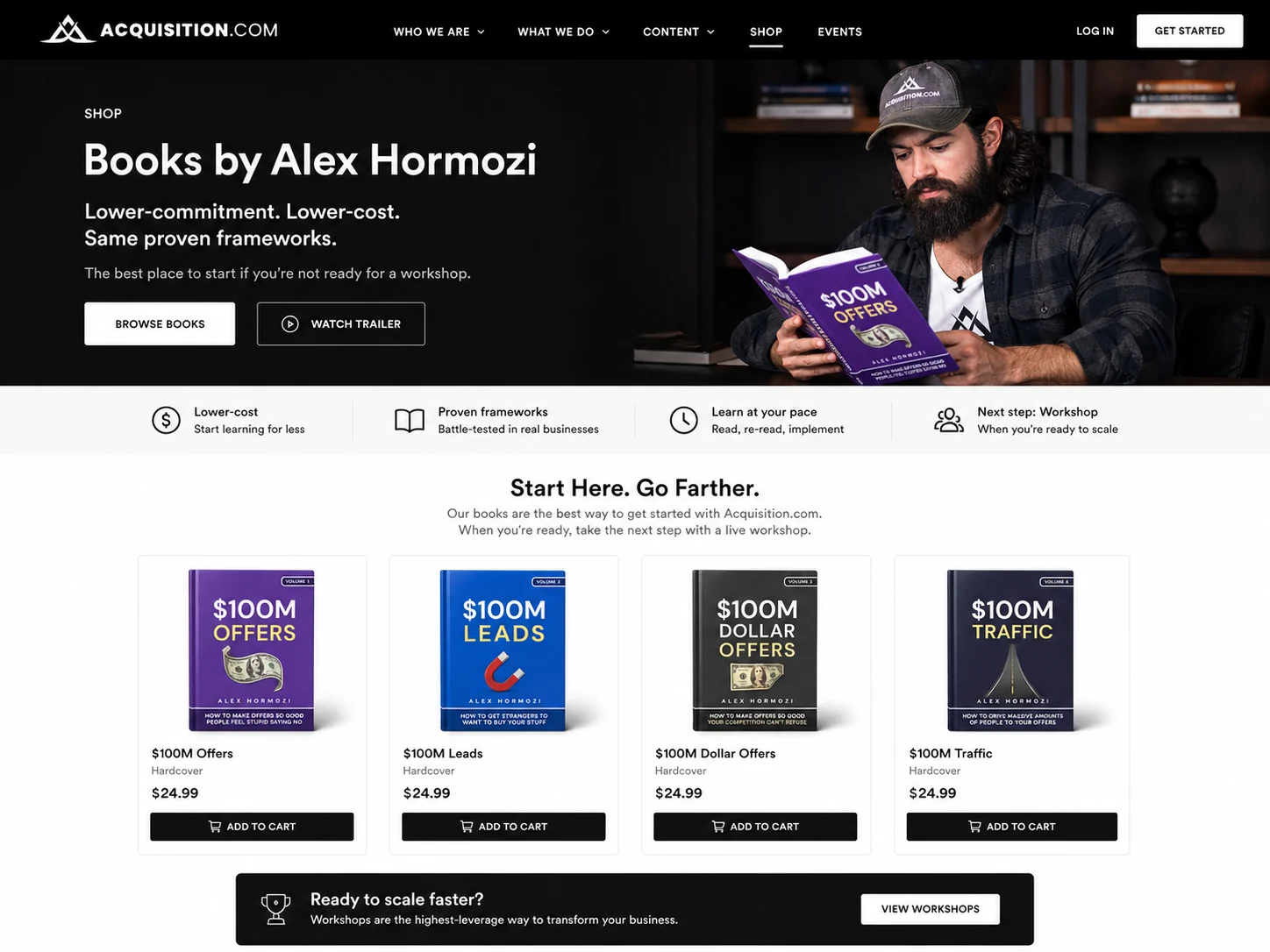
The book path matters because it gives buyers another layer before the workshop. If you want to understand the Hormozi framework without committing to an event, the books are a more reasonable middle step.
Buyer note: Books can teach the framework, but they will not create accountability or custom feedback by themselves.
Scaling Workshop
The workshop is the most serious commercial decision. Public pages present it as a two-day, in-person, tactical experience for business owners who meet qualification requirements.
Buyer note: The workshop should be evaluated like a business investment. Check price, qualification, event schedule, travel, transfer rules, refund rules, and whether your current bottleneck is specific enough to benefit.
Qualification-led next step
A qualification call can be useful because not every buyer is a fit. In theory, that protects both sides.
Buyer note: Do not treat qualification as proof you should buy. Use the call to clarify fit, terms, and expectations before committing.
Pricing and plan value
Acquisition.com pricing is not one clean SaaS plan table.
That is why the buyer has to separate the paths:
| Path | Buyer meaning |
|---|---|
| Free courses and training | Best first step for nearly everyone |
| Free scaling roadmap | Useful diagnostic before paid education |
| Books and shop products | Lower-cost way to study the framework |
| Scaling Workshop | High-ticket, qualification-based, in-person decision |
| Broader firm or partner routes | Not a normal self-serve checkout decision |
At the time of review, public Acquisition.com pages show free training and a free personalized roadmap. Public workshop pages have also shown a $5,000 per-seat ticket route. Buyers should still verify the live workshop page and checkout terms because event dates, qualification requirements, included benefits, and transfer/refund language matter more than a stale price reference.
The entry value is clearly the free path. That is not a throwaway point. With many business education brands, the free content is mostly a teaser. Acquisition.com appears to offer enough public material that a careful buyer can test the thinking before moving into a paid commitment.
The workshop is different. It only makes sense if the buyer has a business stage and constraint that justify tactical help. If the free content has not helped you make or test a real decision, I would not treat the workshop price as the next logical step.
Pricing check: If Acquisition.com still fits your business stage, verify the current workshop route, free training path, and offer details before checkout.
Check Acquisition.com pricing Read store guide Check current offers
Free plan, trial, coupon, and checkout notes
Acquisition.com does not behave like a product with a normal free trial.
The free path is education-driven: courses, videos, roadmap tools, and public content. That is better than a seven-day trial for this category because the buyer is not testing software access. The buyer is testing whether the frameworks produce useful business thinking.
The coupon question should come later.
I would not start with “does Acquisition.com have a coupon?” I would start with “did the free material help me make a better business decision?” If the answer is no, a coupon does not solve the problem. If the answer is yes and the workshop fit is strong, then checking the Acquisition.com coupon page before checkout is reasonable.
For shop products, check the current shop terms. For workshop access, check the current event terms. Do not assume refund treatment is identical across books, merchandise, event registration, and any follow-up paid route.
Offer caution: Use the coupon route only after the free content and workshop fit are already clear. A discount should improve a good decision, not create one.
What I would check before buying Acquisition.com
If I were buying this for a real business workflow, I would check these items before paying:
- Whether the free roadmap identifies a constraint I already believe is real.
- Whether one free course has produced an action I can implement now.
- Whether the workshop qualification requirements match my current business stage.
- Whether the live ticket price, date, location, and included benefits are clear.
- Whether travel, lodging, and time away from the business change the real cost.
- Whether current refund, cancellation, and transfer terms are acceptable.
- Whether a narrower course or lower-cost route would solve my actual problem first.
The easy mistake is treating the workshop as a shortcut.
The better question is whether you can walk in with a specific constraint and walk out with actions you will actually implement. Without that, the event may still be impressive, but the purchase becomes harder to justify.
A simple test before paying
Before paying for any higher-ticket Acquisition.com route, I would run a small test like this:
- Choose one constraint: offer, leads, hiring, profit, strategy, or operations.
- Complete one related free course or roadmap step.
- Turn the advice into one measurable business action.
- Run that action long enough to see whether it changes behavior or numbers.
- Write down the questions you still cannot answer alone.
- Compare those questions against the workshop promise and qualification page.
- Only then decide whether a call or paid seat is the right next step.
This test is not complicated. That is the point.
If the free material does not create useful movement, the paid workshop may not be the next best move. If the free material exposes a clear bottleneck and you need tactical feedback, the workshop becomes a more serious option.
Pros explained
The free education path is unusually useful
The strongest buyer-friendly part of Acquisition.com is that you can start without paying. Courses, roadmap tools, videos, and books give a founder enough context to evaluate the framework before moving into a workshop decision.
That matters because business education is often sold too quickly. A free diagnostic path creates a better first step.
The positioning is practical rather than purely motivational
Acquisition.com does use strong founder branding, but the public education angle is more operational than vague inspiration. Topics such as offers, leads, money models, hiring, profit, and strategy are real business levers.
This is useful when the buyer has a specific constraint. It is less useful when the buyer is still looking for general confidence.
The workshop fit filter can protect buyers
A qualification-led workshop is better than an open checkout when the product is not right for everyone. The public pages make clear that business stage and fit matter.
That does not mean every qualified buyer should pay. It means the decision should be handled as a fit conversation, not a low-friction impulse purchase.
The ecosystem gives buyers multiple entry points
You do not have to jump straight to a workshop. You can start with free content, books, roadmap tools, or the store guide. That makes Acquisition.com easier to evaluate carefully.
The benefit stops being enough if a buyer ignores the sequence and treats the paid route as the default.
Cons explained
The workshop is not a casual purchase
A $5,000-style workshop route, plus travel and time, is a serious business expense. Even if the content is strong, the purchase needs a real business case.
The buyer risk is overestimating the value of access and underestimating the work required after the event.
Refund and event terms deserve close attention
Official terms and event pages use strict refund and transfer language. That makes live verification important before payment.
This does not make Acquisition.com unusual in the event category, but it does mean buyers should not treat the purchase like a flexible monthly subscription.
Beginner fit is limited
Beginners may enjoy the content, but the paid workshop path is harder to justify before demand, sales, and operational bottlenecks exist.
At the early stage, free content and books are usually the more reasonable route.
The brand can make the decision feel easier than it is
Alex and Leila Hormozi have a large audience and strong credibility. That can help buyers pay attention, but it can also make them skip their own fit check.
The safer path is to evaluate the constraint, not the excitement.
Green flags and red flags
| Signal type | What to look for |
|---|---|
| Green flag | The free roadmap identifies a constraint you already see in the business |
| Green flag | A free course produces an action you can apply immediately |
| Green flag | Your business has enough revenue and complexity for tactical feedback to matter |
| Green flag | You know exactly what question you would bring to a workshop or call |
| Red flag | You are buying mainly because of the Hormozi brand, not because of a specific bottleneck |
| Red flag | You have not made use of the free content yet |
| Red flag | The workshop price would create cash-flow pressure |
| Red flag | You have not read current event, refund, transfer, and cancellation terms |
The most important red flag is not price by itself.
It is lack of implementation readiness. If you cannot act on advice after the event, the purchase becomes much harder to defend.
Acquisition.com vs alternatives
Acquisition.com is broad. The closest DealBestDaily comparison routes are not perfect one-to-one replacements, so I would treat them as adjacent education paths rather than direct clones.
Amazing Selling Machine vs Acquisition.com
Amazon Selling Machine is the better route if the buyer specifically wants Amazon FBA training. It is more channel-specific.
Acquisition.com may still make more sense if the buyer already has a business and needs broader scaling thinking around offers, leads, people, profit, or strategy.
One Funnel Away Challenge vs Acquisition.com
One Funnel Away Challenge is closer to a funnel-building and sales-process training route. It can be a better fit for buyers who know their immediate problem is funnel execution.
Acquisition.com is broader and more founder-operator focused. That breadth helps when the constraint is unclear, but it can be too wide if the buyer only needs funnel mechanics.
Vince Ecom Mastery vs Acquisition.com
Vince Ecom Mastery is more relevant when ecommerce execution is the main learning path. It is not trying to be a full founder scaling ecosystem.
Acquisition.com may be better for a business owner whose problem goes beyond ecommerce tactics and into management, growth strategy, profit, or team constraints.
Funnel Builder Secrets-style offers vs Acquisition.com
Funnel Builder Secrets-style offers are more adjacent to offer creation, funnel software, and sales conversion.
That route may be better if the buyer wants a specific sales funnel path. Acquisition.com is better when the buyer needs a broader business-stage diagnosis.
Trust, refund, and buyer-risk notes
Acquisition.com has strong public brand signals, but trust still depends on fit, terms, and expectations.
The first trust point is the free path. A buyer can study courses, use the roadmap, read book material, and evaluate the teaching before paying for the workshop. That is good.
The second trust point is the public qualification language. Acquisition.com does not present the workshop as a casual fit for everyone. That helps, but it also means buyers need to be honest about their stage.
The biggest risk area is paid-event commitment. Public terms and workshop materials include strict language around payment, refunds, transfers, attendance rules, and event logistics. Before paying, buyers should read the current terms attached to the exact purchase path. A shop product, a workshop ticket, and a broader business route may not carry the same rules.
Data and contact consent also matter. The roadmap page asks for contact information and includes consent language for phone, text, or email follow-up. That is normal for a business education funnel, but buyers should understand what they are opting into before submitting details.
I would also separate testimonials from guarantees. Public pages can show impressive outcomes and strong founder credibility, but the official disclaimers are clear that results vary. That is the correct lens. Education can improve decision-making, but it does not guarantee growth.
Final verdict
I would consider Acquisition.com if you are an active founder with a real constraint, you already respect the Hormozi framework, and the free material has produced useful thinking or action in your business.
I would start with the free roadmap, free courses, and book-level material before treating the workshop as the next step.
I would skip the paid route for now if you are still validating an idea, if the workshop price would create financial pressure, or if you are mainly chasing access because the brand is exciting.
I would compare Acquisition.com with a narrower education route if your problem is already specific: Amazon FBA, ecommerce, funnel-building, or offer mechanics.
The safest judgment is simple: Acquisition.com can be valuable, but only after the buyer has done the free homework, verified the current terms, and confirmed that the paid path matches a real business bottleneck. The workshop should be a fit decision, not a motivation purchase.