Quick verdict
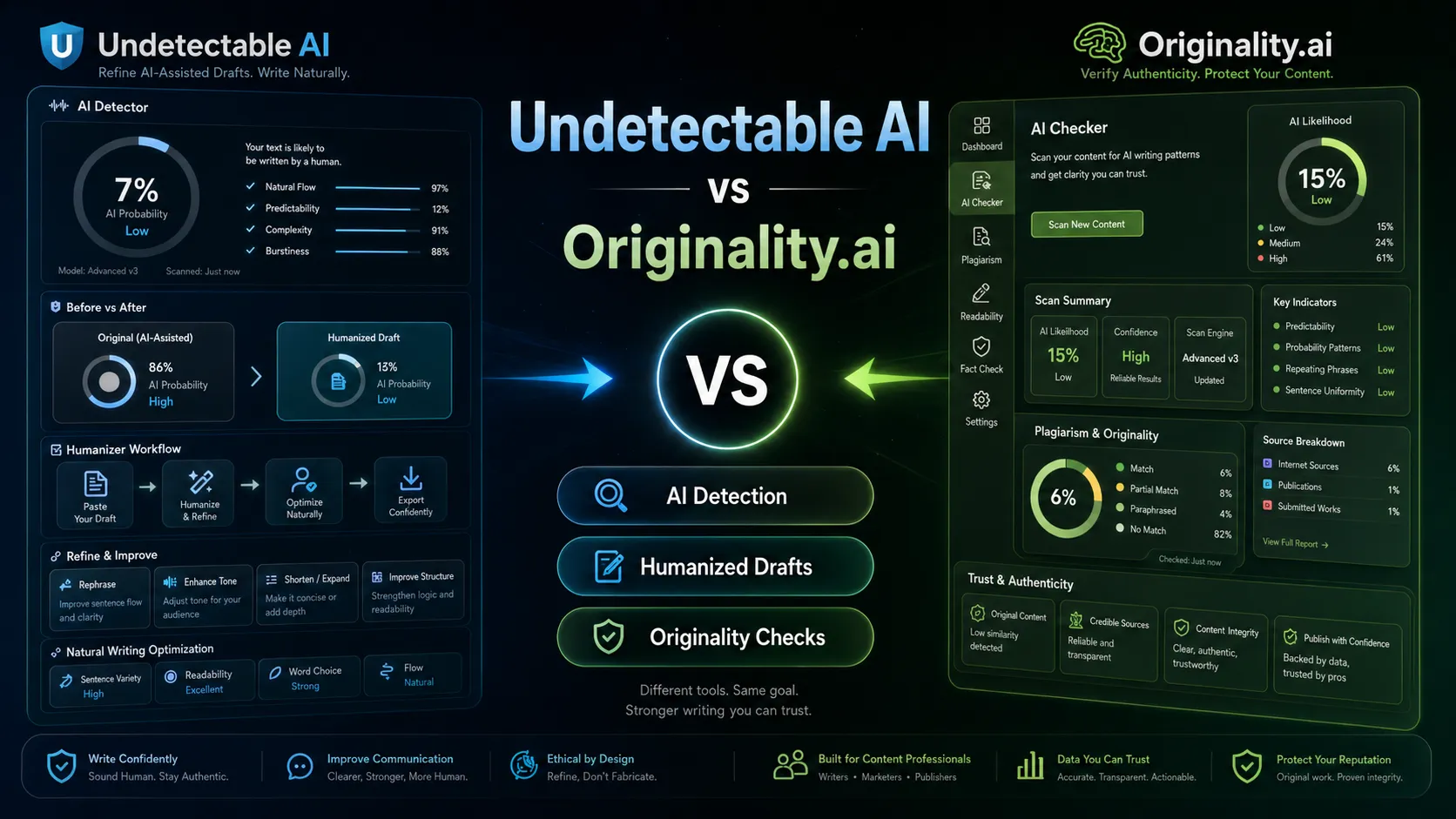
Choose Undetectable AI if your real job is draft-level polishing. It fits writers, marketers, and small content teams that want to check whether AI-assisted working text may look machine-shaped, then run a humanizer pass only after they still plan to edit the result themselves.
Choose Originality.ai if your real job is publishing review. It is the stronger fit for agencies, publishers, SEO teams, educators, and businesses that need AI detection, plagiarism checking, readability support, reports, integrations, API access, and a repeatable content QA process before something goes live.
My practical recommendation: Undetectable AI is the better first click for a free detector plus humanizer workflow. Originality.ai is the safer pick for originality and content-quality checks at scale. One helps revise a draft. The other helps review a draft.
At-a-glance comparison
| Decision point | Undetectable AI | Originality.ai |
|---|
| Best fit | Free detection plus humanizing AI-assisted drafts | AI detection, plagiarism, and content QA |
| Main buyer job | Make working text sound more natural after review | Inspect content before publication or delivery |
| Starting path | Free AI detector and paid word-volume plans | Pay-as-you-go credits or subscriptions |
| Pricing style | Monthly and annual word-volume tiers | Credits, Pro subscription, Enterprise subscription |
| Team fit | Useful for writers, marketers, agencies, and bulk-credit buyers | Stronger for publishers, agencies, schools, and content teams |
| Main risk | Over-trusting humanizer claims or policy fit | Over-trusting detector scores as final proof |
| Best next step | Test a real draft with the free detector | Estimate monthly scan volume before buying credits |
What Undetectable AI is better at
Undetectable AI is better when the workflow starts with a rough AI-assisted draft. Its product family centers on AI detection, humanizing text, sentence rewriting, business solutions, API access, and related checking tools. The simple buyer path is: check a draft, see whether it may be flagged, then decide whether a humanizer pass is worth testing.
That makes it attractive for writers, freelancers, content marketers, and small teams that already use AI as a drafting assistant but do not want to publish robotic copy. The free detector gives buyers a low-friction first test. Paid plans then scale by monthly word volume, which is easier to understand than a broad QA platform with several scan types.
The important caution is intent. Undetectable AI should be treated as a draft-polishing and authenticity-review tool, not as a way to ignore disclosure rules. If a client, school, workplace, publisher, or platform requires transparency around AI-assisted writing, a humanizer does not remove that responsibility.
What Originality.ai is better at
Originality.ai is better when the workflow starts with review. Its value is not rewriting a paragraph. It is checking content before someone publishes, accepts, invoices, uploads, or sends it to a client. The platform combines AI detection with plagiarism checking, readability checks, grammar and spelling support, fact-checking support, content optimization, team workflows, integrations, and API access.
That makes Originality.ai more useful for content operations. A publisher may need to scan outsourced articles. An agency may need to review drafts from several writers. A school may need a structured review signal. A WordPress site owner may want checks closer to publishing. A developer may need API access instead of a browser-only checker.
Originality.ai still should not be treated as final proof. AI detection is a risk signal, not a complete judgment about authorship or intent. Mixed drafts, rewritten text, editing history, false positives, false negatives, and model changes can all complicate results. But if the buyer needs a repeatable inspection process, Originality.ai is the more serious platform.
Choose Undetectable AI if…
Choose Undetectable AI if you are mainly trying to improve the feel of AI-assisted working text before a manual editorial pass. It fits when the draft is too flat, too generic, or too obviously shaped by an AI tool, but you still plan to check facts, examples, tone, structure, sources, and compliance yourself.
It is also a better fit if you want a free first step. The detector path lets you test whether a sample may raise AI-detection concerns before you pay for a word-volume plan. That matters because humanizer tools can look cheap until your real monthly word count is higher than expected.
Undetectable AI is the stronger choice when the problem is draft voice and naturalness. It is not the stronger choice if the problem is plagiarism checking, publisher governance, audit trails, site-wide scanning, or team reporting.
Choose Originality.ai if…
Choose Originality.ai if you manage content that needs to be checked before it is trusted. That includes outsourced blog posts, AI-assisted SEO drafts, guest posts, classroom submissions, agency deliverables, product descriptions, site content, and editorial workflows where multiple people need consistent review standards.
Its advantage is operational depth. You are not only asking, “Does this sound human?” You are asking whether a draft may be AI-heavy, whether it has plagiarism risk, whether it is readable, whether reports should be shared, and whether the workflow should connect to Chrome, Google Docs, WordPress, Moodle, or an API.
Originality.ai is the stronger choice when the problem is editorial confidence and originality review. It is not the most efficient choice if all you need is a fast rewrite of one short working paragraph.
Avoid both if…
Avoid both if you are trying to make a policy problem disappear. If the real issue is that AI use is not allowed, must be disclosed, or needs approval, neither a detector nor a humanizer fixes the ethical or contractual question.
Also avoid both if you need final proof of authorship. Originality.ai can support a review process, and Undetectable AI can show whether text may trigger certain detection patterns, but detector outputs should not be treated as the only evidence in high-stakes decisions.
Finally, avoid both if the draft simply needs better thinking. Weak claims, missing examples, thin product research, generic structure, and unsupported statements are not fixed by a detector score or a humanizer pass.
Pricing and plan fit
Undetectable AI is a word-volume decision. The public pricing page shows a free trial path and paid tiers based on monthly words, with annual billing lowering the monthly equivalent. The main thing to verify is not only the visible monthly price. Check the charged annual total, word allowance, higher-volume options, business-credit terms, cancellation language, and whether remaining words disappear when the subscription ends.
Originality.ai is a credit-volume decision. The public pricing path separates pay-as-you-go credits from Pro and Enterprise subscriptions. Pay-as-you-go can be cleaner for occasional scanning because unused credits have a longer expiry window. Subscription credits are better for recurring workflows only if the buyer actually uses the monthly allowance before credits reset.
Refund terms also differ. Undetectable AI’s terms describe a narrow credit-refund condition tied to performance and timing, while also saying refunds are generally not provided unless required by law. Originality.ai’s refund policy is case-by-case and discretionary. In both cases, buyers should treat refund flexibility as limited and test the workflow before committing to annual billing or higher-volume plans.
Workflow fit: humanizer path vs QA system
With Undetectable AI, the likely workflow is: paste a draft, run a detector check, humanize if needed, then manually review the result. The final manual review matters. A polished draft can still have weak facts, unclear sourcing, awkward transitions, or policy issues.
With Originality.ai, the likely workflow is: scan text, review AI and plagiarism signals, inspect readability or quality checks, share reports, tag scans, connect the workflow to a team or CMS, and decide whether the draft needs revision, disclosure, rejection, or deeper human review.
Those workflows can complement each other, but they should not be confused. A humanizer may reduce robotic phrasing. A QA platform may reduce publishing risk. The right tool depends on whether the buyer’s bottleneck is editing the draft or approving the draft.
Team and business use
Undetectable AI can make sense for agencies or teams that need bulk word volume, API compatibility, non-expiring business credits, white-label or redistribution discussions, and a simple humanizer workflow around many AI-assisted drafts. The buyer should verify the business path directly because bulk credits, API terms, redistribution permissions, and support coverage can matter more than the public self-serve price.
Originality.ai is usually stronger for teams that need structured review. Its value increases when multiple editors, writers, clients, or publishing systems are involved. Shareable reports, scan history, integrations, and API access make it easier to turn checking into a repeatable process rather than a one-off paste box.
Buyer checklist before checkout
Before choosing Undetectable AI, check:
- Have you tested the free detector on a real working draft, not a random sample?
- Does the humanized output preserve meaning, facts, citations, tone, and brand voice?
- How many words do you need to process each month?
- Is annual billing actually cheaper for your usage, or just cheaper on the price label?
- Does your client, school, workplace, or publisher allow the kind of AI-assisted editing you plan to do?
- Have you read the current cancellation and refund language before paying?
Before choosing Originality.ai, check:
- How many words will you scan each month across all writers, clients, or sites?
- Do you need AI detection only, or also plagiarism, readability, grammar, fact-checking, reports, integrations, and API access?
- Will pay-as-you-go credits be enough, or do you need recurring monthly credits?
- Do you understand credit expiry before choosing a plan?
- Who will review the results so detector scores do not become the only decision point?
- Have you checked the refund policy and billing interval before checkout?
Coupon, trial, and savings path
For Undetectable AI, the safer path is to start with the free detector and trial-style entry before moving into a paid word-volume plan. If the workflow fits, compare monthly versus annual billing and verify the live checkout total. You can also check the Undetectable AI store page, Undetectable AI review, and Undetectable AI coupon route before paying.
For Originality.ai, the safer savings path starts with plan fit. Estimate monthly scan volume, then compare pay-as-you-go, Pro, and Enterprise. Annual billing can matter for recurring users, but only if the credit allowance and expiry rules match real use. After choosing the right plan type, check the Originality.ai store page, Originality.ai review, and Originality.ai coupon route for current checkout guidance.
If a live coupon route shows a hidden code or limited offer, verify the final checkout total before paying. A discount should support the right workflow decision. It should not push you into the wrong product.
Final verdict
Pick Undetectable AI if your main problem is improving AI-assisted working drafts after a detection check. It is the better fit for writers, marketers, freelancers, and small teams that want a free detector first and a paid humanizer only when the output actually improves their editing workflow.
Pick Originality.ai if your main problem is content QA before publication. It is the better fit for publishers, agencies, SEO teams, educators, and developers that need AI detection, plagiarism review, reporting, integrations, credit planning, and a repeatable approval process.
The practical decision is simple: Undetectable AI is for revising the draft. Originality.ai is for reviewing the draft. If the draft sounds robotic, start with Undetectable AI’s free detector and test one real piece of text. If the publishing risk is bigger than the wording problem, start with Originality.ai’s credit model and workflow features.
FAQ
Is Undetectable AI better than Originality.ai?
Undetectable AI is better if you want a free detector plus a humanizer workflow for AI-assisted working drafts. Originality.ai is better if you need AI detection, plagiarism checking, reports, integrations, and repeatable content QA.
Is Originality.ai an Undetectable AI alternative?
Only partly. Both sit in the AI-detection category, but they solve different jobs. Undetectable AI focuses more on detection plus humanizing text. Originality.ai focuses more on originality checking, plagiarism review, and publisher-style QA.
Can Undetectable AI guarantee that content will pass every detector?
No buyer should treat any humanizer as a guaranteed pass across every detector, client policy, school policy, publishing standard, or future detection model. Use it as a draft-polishing tool and review the output carefully.
Can Originality.ai prove that someone used AI?
Originality.ai can support a review process, but detector results should be treated as signals rather than final proof. Mixed writing, heavy editing, rewritten AI text, false positives, and false negatives can all affect interpretation.
Originality.ai is usually safer for SEO teams that need recurring QA across outsourced or AI-assisted content. Undetectable AI can help polish working drafts, but it does not replace plagiarism checks, reports, scan history, or editorial governance.
Which one should a solo writer try first?
A solo writer who only wants to improve the feel of AI-assisted drafts may start with Undetectable AI’s free detector and humanizer path. A solo writer who publishes at volume, accepts guest posts, or reviews outsourced drafts should also compare Originality.ai’s pay-as-you-go credits.