Quick verdict
AnotherWrapper is worth a serious look if you are building an AI SaaS product and you already know you want a code-first Next.js foundation.
That last part matters more than the landing page excitement.
This is not a normal SaaS tool where you sign in, click a few buttons, and get a finished hosted product. It is a commercial source-code product: AI app templates, SaaS infrastructure, provider wiring, auth, payments, database, storage, analytics, and docs that are supposed to help you move faster from idea to launch.
For the right buyer, that can be valuable. If you are a solo technical founder who has already built enough SaaS plumbing to hate repeating it, AnotherWrapper can look like a shortcut with a real use case. If your product idea is close to one of its included AI app patterns, the time saved may matter more than the one-time price.
But I would be careful if you are buying it because the headline price feels lower than hiring a developer. A boilerplate is only a bargain when you can actually use the stack, understand the code, connect the providers, configure payments, and maintain the product after launch.
The safest read is this: AnotherWrapper is a promising AI-first starter kit for technical builders, not a push-button no-code business. Before paying, I would check the docs, demo apps, license scope, update access, refund language, and the exact tier shown at live checkout.
Next step: If AnotherWrapper still fits your build plan, verify the current tier, license, and checkout terms before paying.
Review snapshot
| Review point | Practical take |
|---|---|
| Best for | Developers and technical founders building AI SaaS products with Next.js |
| Not ideal for | Non-technical buyers, no-code users, or teams that need a very different stack |
| Main use case | Starting from an AI SaaS codebase with app patterns, auth, payments, providers, and deployment docs |
| Pricing note | Public pricing is presented as a one-time purchase, but buyers should verify the current tier and checkout page |
| Free path | No verified free plan for the full commercial codebase; public tools and demos can help evaluation |
| Main strength | AI-specific starter kit with real app patterns instead of only generic SaaS scaffolding |
| Main concern | License scope, refund wording, updates, support, provider costs, and technical fit need careful checking |
| Direct alternatives | ShipFast, MakerKit, Supastarter |
| Adjacent route | AdminKit if the buyer mainly needs dashboard/admin structure |
| Best next step | Inspect docs and demo apps before choosing a paid tier |
What is AnotherWrapper?
AnotherWrapper is an AI SaaS starter kit and Next.js boilerplate for developers who want to launch AI-powered products faster.
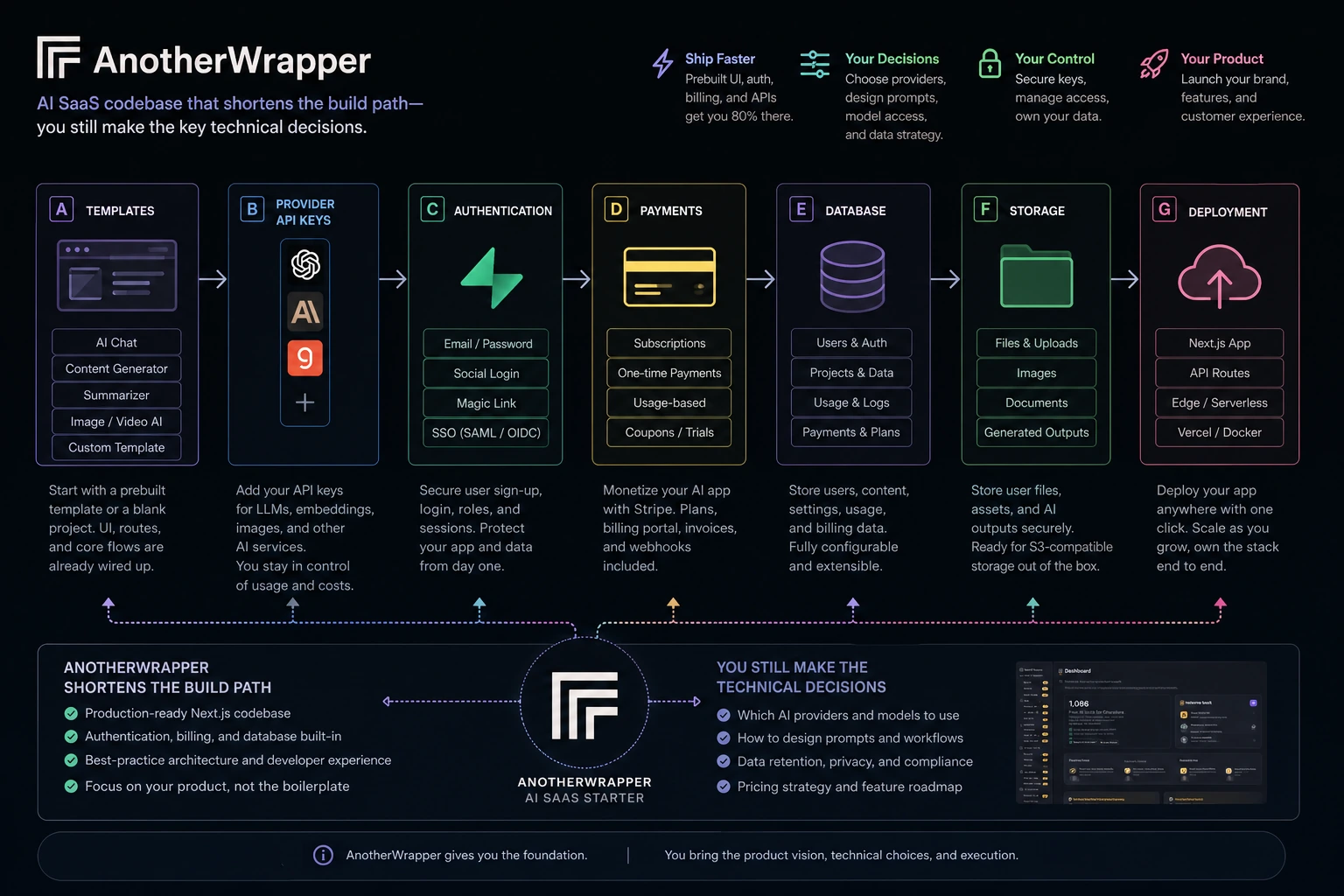
The simplest way to understand it is this: instead of starting with a blank app and spending weeks wiring authentication, payments, database, AI provider calls, credits, storage, analytics, and landing pages, you start from a codebase where many of those pieces are already connected.
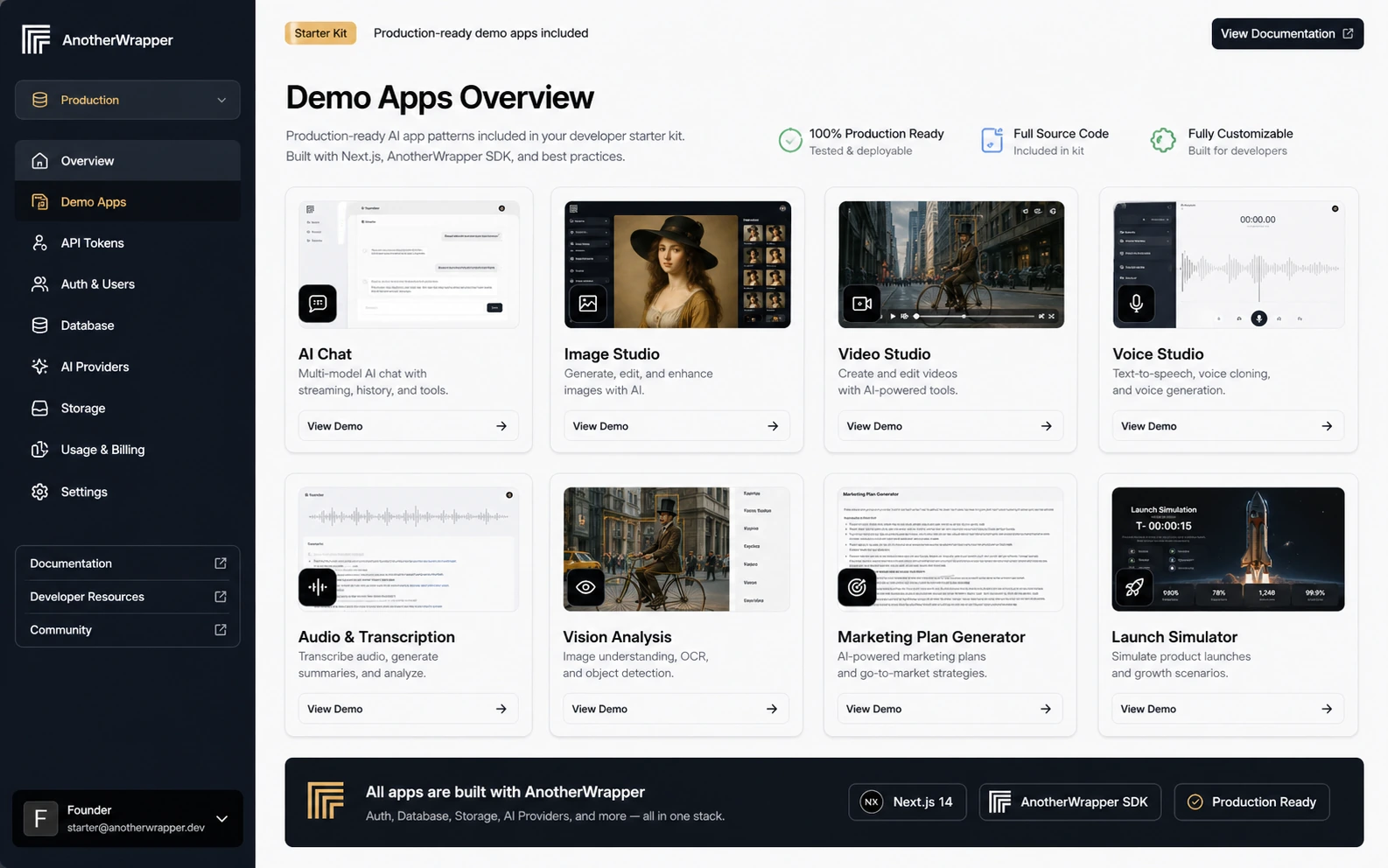
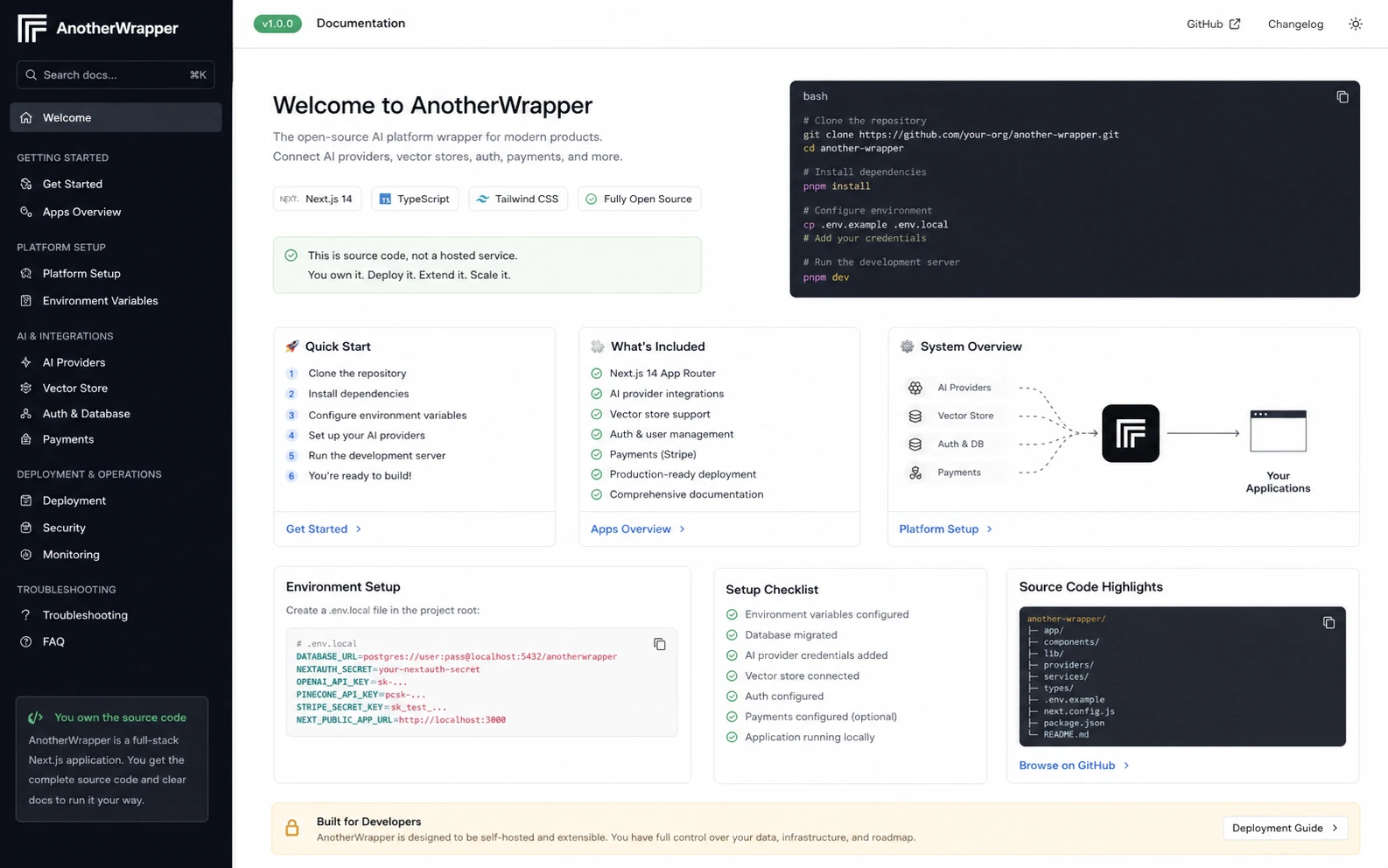
The official positioning is strongly AI-first. AnotherWrapper presents itself as a Next.js starter kit for launching AI SaaS products, with production-ready AI templates that can be customized into a product. The docs describe a broader build path: local setup, app overview, platform setup, providers, payments, deployment, security, monitoring, troubleshooting, and a launch checklist.
That makes it different from a plain SaaS starter. It is not only “auth plus Stripe plus landing page.” The value proposition is closer to: “Here is a working foundation for AI wrappers and AI micro-SaaS apps, with demo app patterns you can adapt.”
It is also not a no-code builder.
This is the common misunderstanding. AnotherWrapper can reduce setup work, but it does not remove software work. You still need to clone the repo, understand the structure, configure services, bring your own provider keys, test payments, deploy safely, and make product decisions. If you are not comfortable with that, the low-friction marketing can make the purchase feel easier than the actual implementation.
Our review approach compares public product pages, pricing details, docs, terms, buyer workflow fit, and nearby boilerplate alternatives. I would not treat a low one-time price, a demo page, or a coupon path as proof that the codebase fits the buyer.
Who should use AnotherWrapper?
AnotherWrapper makes the most sense for builders who know they are creating an AI-heavy product and want to avoid rebuilding the same foundation again.
Technical solo founders building AI wrappers
If you already know your way around React, Next.js, environment variables, provider keys, and deployment, AnotherWrapper can be a practical shortcut. The fit gets stronger when your idea resembles one of the included app patterns: AI chat, image generation, voice, audio transcription, vision, marketing planning, or launch simulation.
The condition is simple: you should be able to inspect the docs and understand the build path before buying. If the docs feel confusing, the product probably will not magically become easier after checkout.
Developers who value speed over building everything from scratch
Some developers enjoy building every foundation piece themselves. Others just want auth, payments, database, credits, AI provider layers, and starter UI out of the way so they can focus on the product.
AnotherWrapper fits the second group better.
The buyer should still verify whether the chosen tier includes the demo apps, model support, updates, and license rights needed for the actual project.
Small teams building AI-first MVPs
A small technical team may like AnotherWrapper if the goal is to test an AI SaaS idea quickly without creating a custom foundation from zero. The value is strongest when the team can adapt the codebase rather than fight it.
I would be more cautious if the team needs advanced B2B permissions, deep multi-tenancy, strict compliance controls, or a custom architecture. Those needs can turn a starter kit into a negotiation with someone else’s assumptions.
Agencies or client builders who understand license scope
AnotherWrapper may be useful for agencies building AI tools for clients, but this is where license terms matter. Client work, multiple products, white-label usage, and developer seats can change the correct tier.
Before using it for client delivery, I would verify license language, support access, update terms, redistribution limits, and whether the current tier clearly allows the intended commercial use.
Who should avoid AnotherWrapper?
AnotherWrapper is not for every buyer who wants to “launch an AI app.”
Non-technical buyers should be careful. If you cannot work with source code, provider keys, deployment settings, and payment configuration, this is not the same as buying access to a finished hosted SaaS app.
Developers who dislike the stack should also slow down. A boilerplate is only a shortcut when the stack matches your preferences. If you prefer a different framework, database, auth layer, payment setup, or deployment style, the time saved can disappear quickly.
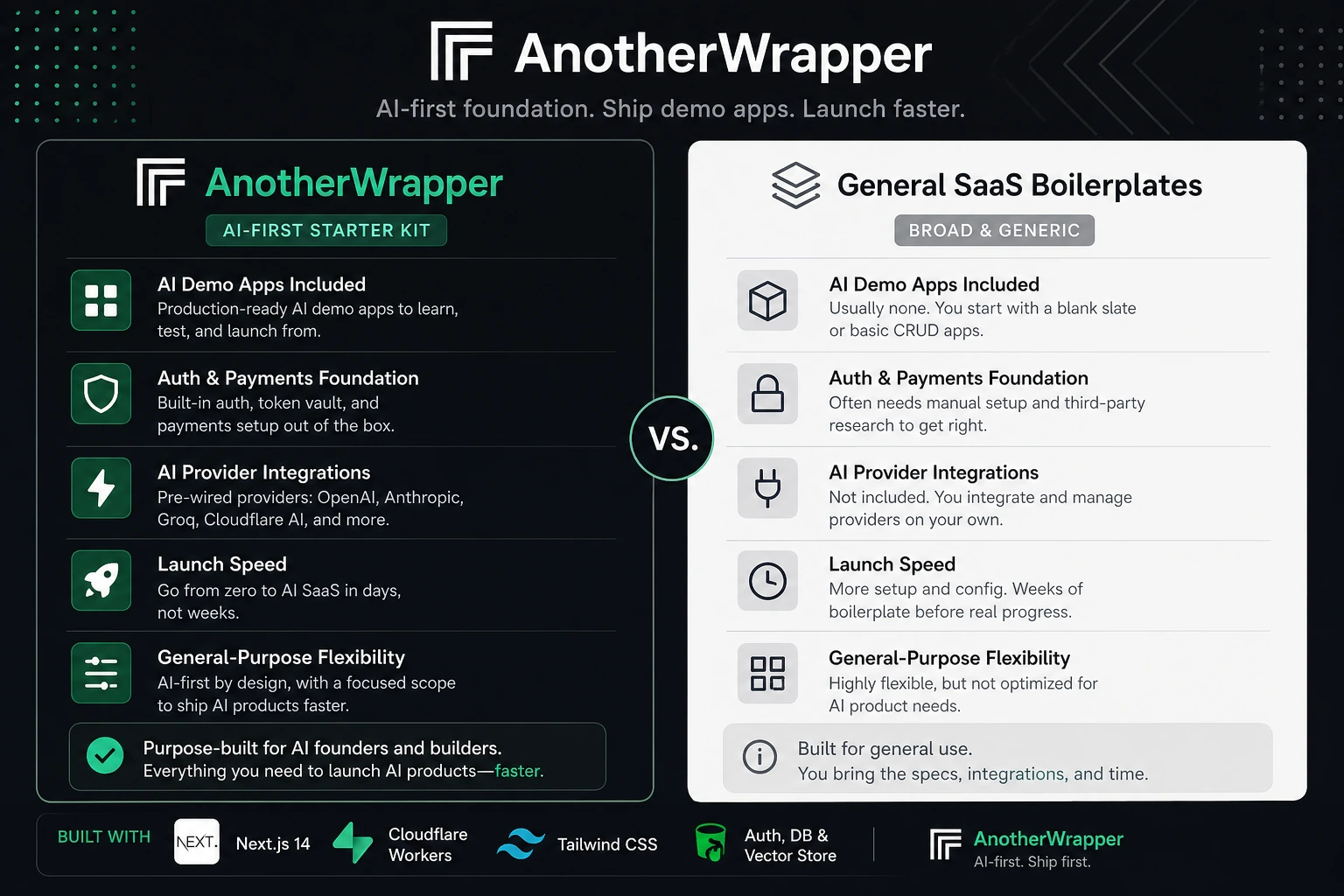
Teams building mostly non-AI products may be better served by a broader SaaS boilerplate. AnotherWrapper’s strongest angle is AI-specific app templates and provider wiring. If your product is a standard CRM, directory, marketplace, or internal dashboard, a more general starter may fit better.
Buyers who need enterprise-grade governance out of the box should also compare carefully. AnotherWrapper can be a foundation, but the public positioning is not the same as a fully packaged enterprise platform with every admin, permission, audit, and compliance path already solved.
I would also avoid buying only because of a launch price, crossed-out anchor price, or coupon path. The easy mistake here is treating the discount as the decision. The better way to judge it is to open the docs, compare the tier rights, and ask whether the codebase gets you closer to your actual product.
How AnotherWrapper fits into a real workflow
A practical AnotherWrapper workflow starts before checkout.
The first step is to define the product you want to build. Not “an AI app” in general. A specific product: chatbot with documents, image tool, video workflow, voice product, transcription product, vision tool, AI marketing planner, or another AI-heavy SaaS pattern.
Then compare that product against the included demo apps and docs. If one of the patterns is close, AnotherWrapper becomes more interesting. If every included app feels distant, you may be paying for code you will delete.
A realistic workflow looks like this:
- Choose the app pattern closest to your product.
- Read the setup and project structure docs.
- Check provider requirements and external costs.
- Confirm the payment provider and billing model you plan to use.
- Review auth, database, storage, credits, analytics, and deployment notes.
- Pick the tier that matches your developer seats, update needs, and commercial use.
- Build a small internal version before turning it into a customer-facing product.
- Test payments, rate limits, errors, security, and provider billing before launch.
The useful part is that many early decisions are already mapped. The risky part is that the codebase can make you feel further along than you really are. A working demo is not the same as a validated product. It still needs positioning, pricing, onboarding, support, legal pages, monitoring, and real user testing.
Workflow check: Before choosing a tier, compare the docs and demo apps against the product you actually want to ship.
Real-world buyer scenarios
The solo founder building an AI micro-SaaS
This is the clearest fit. A technical founder wants to test an AI product idea and does not want to spend the first weeks wiring infrastructure. AnotherWrapper can make sense if the founder can customize the code and the idea is close to a supplied app pattern.
Where it can fail: the founder underestimates provider costs, overestimates how finished the starter is, or skips customer validation because the demo looks impressive.
The agency building AI tools for clients
An agency may see AnotherWrapper as a way to ship client projects faster. That can be reasonable, but only if license scope is clear. Client work is not the same as one personal project.
Before paying, I would check whether the chosen tier covers agency use, developer seats, support expectations, and redistribution boundaries. If the license language feels unclear, ask before buying.
The developer comparing boilerplates
A developer may compare AnotherWrapper against ShipFast, MakerKit, Supastarter, or an open-source starter. The decision should not be only price. It should be stack, app examples, docs, community, update quality, support, and how much code you will keep.
AnotherWrapper has a stronger case when AI app patterns are the main value. A broader boilerplate may be better when the product is not primarily AI.
The non-technical buyer looking for a fast AI business
This buyer should slow down. AnotherWrapper may look like a fast launch path, but it still assumes code ownership and technical execution. If you need a hosted AI app maker or no-code workflow builder, this may be the wrong category.
Key features that actually matter
AI-first demo app patterns
The included app patterns are the heart of the offer. Public docs describe apps for chat, image, video, voice, audio, vision, marketing planning, and launch simulation.
Why it matters: a starter kit becomes more valuable when the examples resemble what you want to build.
Buyer note: do not count demo apps like features on a brochure. Open the demos and ask which ones you would actually keep, modify, or remove.
Full SaaS foundation
AnotherWrapper is not only front-end templates. The official material and docs describe platform pieces such as auth, database, storage, credits, email, analytics, payments, provider layers, deployment, and launch checks.
Why it matters: these are the boring pieces that slow a product down before the real product work starts.
Buyer note: this is valuable only if you trust and understand the implementation enough to maintain it.
Provider and model flexibility
The docs point to multiple AI provider areas, including OpenAI, Anthropic, Google Gemini, Groq, xAI, DeepSeek, Replicate, and ElevenLabs.
Why it matters: AI products often need model flexibility as costs, latency, and output quality change.
Buyer note: provider access does not mean provider usage is free. You still need to manage external accounts, billing, API keys, rate limits, and model behavior.
Payments and monetization setup
The docs include payment setup paths such as Stripe, LemonSqueezy, and Polar.
Why it matters: an AI SaaS without billing is only a demo. Payment integration can save time if the structure matches your business model.
Buyer note: payment setup still needs real testing. Webhooks, refunds, taxes, subscriptions, one-time payments, and edge cases can break a launch if you treat them casually.
Documentation depth
The docs are an important buying signal because this is a codebase product. A good boilerplate without usable docs can still cost too much time.
Why it matters: documentation reduces the risk of buying source code that looks good on the homepage but becomes hard to use after purchase.
Buyer note: read the docs before paying. If the setup path, provider pages, payments, deployment, and troubleshooting notes feel understandable, the product risk is lower.
Pricing and plan value
AnotherWrapper uses one-time pricing rather than a normal monthly SaaS subscription, but that does not make the decision simple.
The current public pricing page presents Core at $229, Premium at $249, and Enterprise at $549. Core is framed as an OpenAI-only version, Premium includes all demo apps, open-source models, and access to updates and new apps, and Enterprise is positioned for unlimited developers, B2B solutions, and commercial projects.
That looks straightforward until you look at the real buyer questions.
The price is not only “is this cheaper than hiring a developer?” The better question is: will this codebase save enough setup time in a stack you actually want to use?
I would check these pricing points before paying:
- whether the live checkout tier matches the public pricing page
- whether the plan includes the demo apps you need
- whether developer seats and commercial rights match your use case
- whether updates are included for the period you expect
- whether client work or multiple products require a higher tier
- whether support is enough for your skill level
- whether external provider costs change the real launch budget
One-time pricing can be attractive, especially compared with months of rebuilding SaaS plumbing. But one-time purchase does not remove operating cost. AI provider usage, hosting, storage, email, analytics, payment fees, monitoring, and maintenance are still your responsibility.
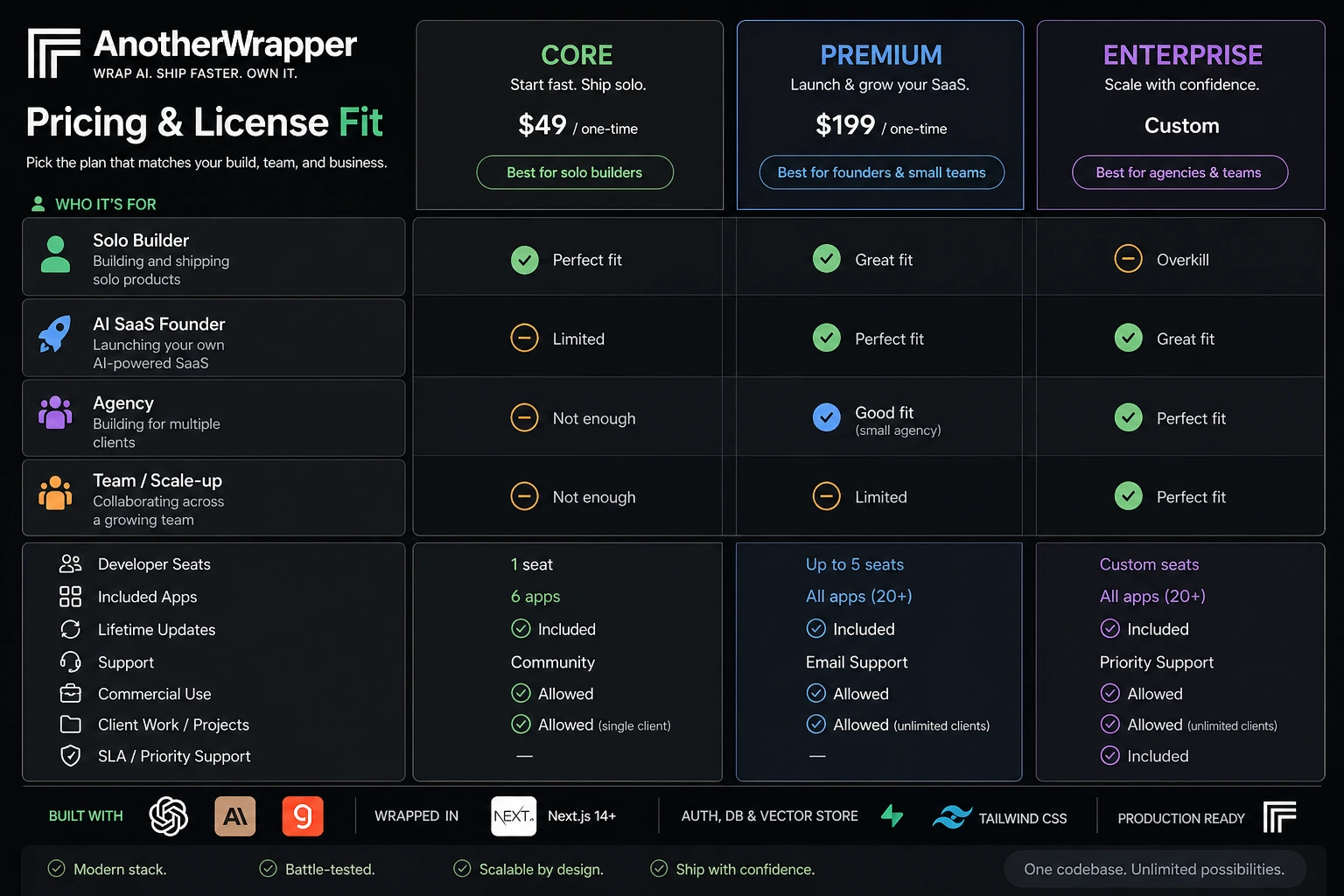
Pricing check: If the codebase fits your stack, verify the live tier, license rights, update terms, and checkout wording before paying.
Free plan, trial, coupon, and checkout notes
A free plan for the full commercial codebase was not verified. AnotherWrapper does provide public tools and demo-style resources, but those should be treated as evaluation aids, not as a free tier for the source-code product.
The refund path is the part I would read slowly.
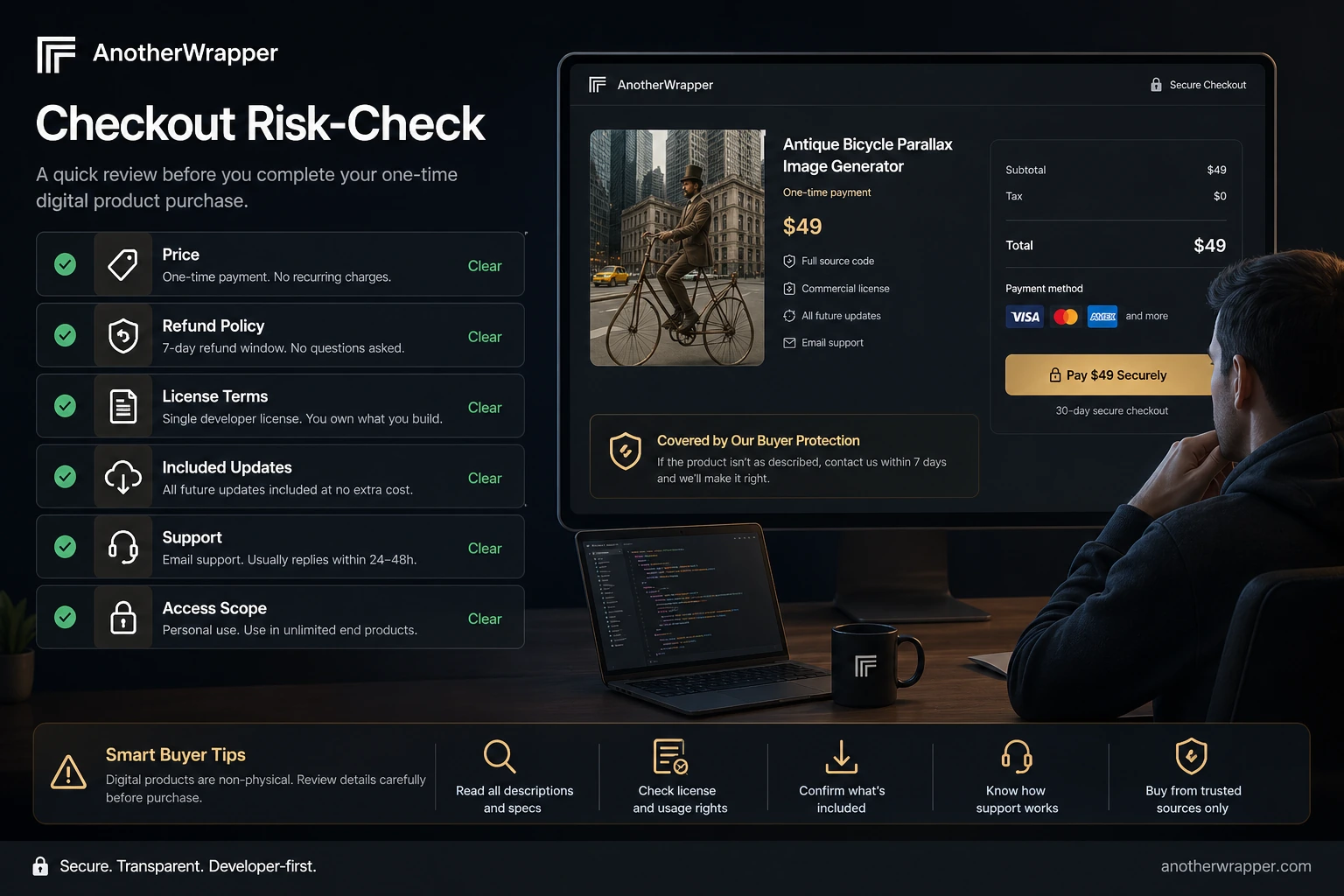
The public marketing pages mention a 14-day money-back guarantee. The terms page also says all sales are final for the digital product after purchase. That mismatch does not automatically mean the product is unsafe, but it does mean buyers should verify the current checkout terms before paying.
For a digital codebase, refund wording matters more than it might for a normal SaaS subscription. Once you receive source-code access, the merchant may treat the sale differently from a cancellable monthly app.
The coupon path should be secondary. Check the AnotherWrapper coupon page only after the stack, tier, license, and refund questions are clear. A better checkout price is useful, but it does not fix a bad fit.
The safe order is:
- Review the demo apps.
- Read the docs.
- Compare tiers and license rights.
- Verify refund and update terms.
- Check live checkout pricing.
- Use the offer route only after the product still fits.
What I would check before buying AnotherWrapper
If I were buying this for a real build, I would not start with the coupon page. I would start with fit.
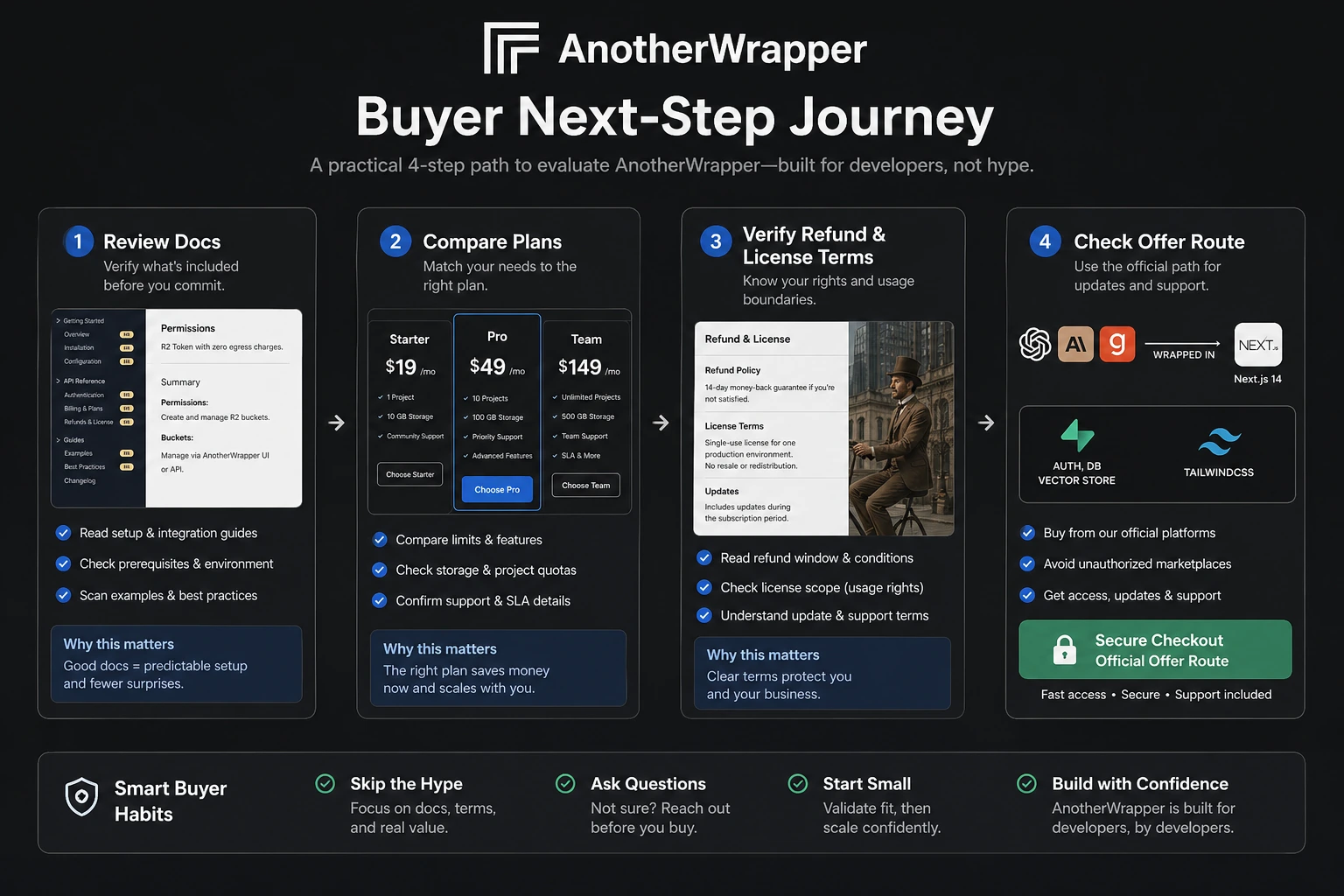
Here is the buyer checklist I would use:
- Stack fit: Are you comfortable building with Next.js, React, TypeScript, Tailwind, database setup, payment providers, and AI provider keys?
- Product fit: Is your planned product close to one of the included AI app patterns?
- Tier fit: Does the tier include the apps, model support, updates, developer seats, and commercial rights you need?
- License fit: Are client work, multiple products, and team usage clearly allowed for your use case?
- Refund clarity: Does the checkout page clearly confirm the refund rule you are relying on?
- Provider cost: Have you estimated AI model usage, hosting, storage, email, and payment-processing costs outside the codebase purchase?
- Support expectations: Do you know where support happens and how much help is included?
The biggest mistake is buying a boilerplate like a finished SaaS subscription. With AnotherWrapper, you are buying a starting point. That starting point may be valuable, but it still becomes your codebase, your product, and your operating responsibility.
A simple test before paying
Before paying, I would run a small desk-check like this:
- Write one sentence describing the AI product you want to launch.
- Match that product to the closest AnotherWrapper demo app.
- Open the docs and follow the setup path mentally from clone to deployment.
- List every external service you would need: AI provider, database, storage, email, analytics, payments, hosting.
- Compare Core, Premium, and Enterprise against your actual license and developer-seat needs.
- Estimate the cost of provider usage after launch.
- Read the live checkout terms and refund language before entering payment details.
This test is intentionally simple. If you cannot complete it, I would not rush into the purchase. If you can complete it and the product still fits, AnotherWrapper becomes easier to justify.
Pros explained
It solves a real developer pain point
The strongest pro is not “AI templates” in the abstract. It is the repeated frustration of wiring the same SaaS foundation over and over.
Auth, payments, database, credits, provider calls, storage, analytics, deployment, and landing pages can delay the part of the product that actually matters. AnotherWrapper is valuable if it removes enough of that setup to let you spend more time on product differentiation.
It stops being enough if your project needs a very different architecture.
The AI-specific focus is useful
Many SaaS starters are broad. AnotherWrapper is more focused on AI app patterns. That makes it more relevant if you are building an AI wrapper, AI micro-SaaS, or model-powered tool.
The focus becomes weaker if your product is not really AI-first. In that case, a broader boilerplate may be cleaner.
One-time pricing can make sense
For a developer who can use the codebase, a one-time purchase can be easier to justify than ongoing monthly software fees.
But the value depends on saved time. If you only keep a small part of the codebase, or if you spend weeks undoing assumptions, the bargain becomes less clear.
The docs reduce purchase risk
For a source-code product, documentation is not a side feature. It is part of the product.
AnotherWrapper’s docs cover setup, app patterns, platform services, AI providers, payments, deployment, security, monitoring, and troubleshooting. That is a positive signal.
The buyer still needs to read those docs before purchase rather than assuming everything will be easy later.
Cons explained
It is not no-code
This is the most important limitation. AnotherWrapper may help you launch faster, but it will not remove the need to understand code, services, deployment, payments, and provider behavior.
If you are buying because you want a finished AI business without technical involvement, this is likely the wrong category.
Refund language needs careful verification
The public marketing path mentions a 14-day guarantee, while the terms page says all sales are final once the software is purchased. That is a buyer-risk note, not a small detail.
Before paying, check the current checkout wording. If refund protection matters to you, ask support before purchase.
External costs are still real
The one-time price covers the codebase, not every operating cost. AI provider usage, hosting, database, storage, email, analytics, payment fees, and support tooling can all add cost.
A buyer who ignores those costs may underestimate the real launch budget.
It may be too opinionated for some teams
Every boilerplate has assumptions. AnotherWrapper’s assumptions may be exactly what you want if you like the stack and AI-first structure.
They may be friction if your team wants different architecture, more mature multi-tenancy, another framework, or a broader non-AI platform foundation.
Green flags and red flags
| Signal | What it means |
|---|---|
| Green flag: your app matches an included demo | The codebase may save real setup time because you can adapt instead of inventing everything |
| Green flag: you understand the docs before buying | You are more likely to use the product instead of getting stuck after checkout |
| Green flag: one-time purchase replaces weeks of repeated setup | The price can make sense when it removes work you would otherwise pay for in developer time |
| Red flag: you need no-code hosting | AnotherWrapper is source code, not a hosted app builder |
| Red flag: refund terms are unclear to you | Digital codebase purchases need clear checkout confidence before payment |
| Red flag: your product is not mainly AI-driven | A broader SaaS starter may fit better than an AI-first template bundle |
| Red flag: you are buying only because of a deal | The discount path should come after stack and product fit, not before |
AnotherWrapper vs alternatives
AnotherWrapper should be compared against SaaS boilerplates and AI app starter kits, not against general AI productivity tools.
ShipFast vs AnotherWrapper
ShipFast is a more direct comparison if you want a broader SaaS launch boilerplate and do not need AI app templates as the main reason to buy.
AnotherWrapper may make more sense when the AI demos, provider wiring, and model-powered product patterns are central to your roadmap.
MakerKit vs AnotherWrapper
MakerKit is a stronger comparison if you care about a more established SaaS foundation, framework choices, team structure, or deeper app architecture.
AnotherWrapper may still be the better fit when you specifically want an AI-heavy Next.js codebase and the included demo apps reduce real build time.
Supastarter vs AnotherWrapper
Supastarter is worth comparing if you want a polished SaaS starter with broad product use cases. It may be more flexible for non-AI SaaS products.
AnotherWrapper is more focused when the buyer’s product is clearly an AI app, AI wrapper, or model-powered tool.
AdminKit as an adjacent route
AdminKit is not a one-to-one replacement for AnotherWrapper. It is an adjacent route for buyers who care more about dashboards, admin structure, or internal UI foundations than AI app templates.
If your main problem is admin experience, not AI provider wiring, AdminKit may belong on the comparison list. If your main problem is launching an AI SaaS product, AnotherWrapper is the more relevant category.
Trust, refund, and buyer-risk notes
The trust picture is mixed in a normal way for commercial codebase products.
On the positive side, AnotherWrapper has a real official site, public docs, demo app positioning, Product Hunt presence, and third-party software-directory mentions. The docs are deeper than a thin landing page. That lowers the risk of buying a vague download.
The caution is that source-code products require a different buying standard from hosted SaaS tools.
I would pay attention to these risks:
- Refund wording: verify the live checkout rule because public guarantee language and terms language can feel different.
- Update access: terms mention one year of free updates, while marketing language can emphasize lifetime-style access. Confirm what future updates mean for the tier you buy.
- License scope: check whether personal, commercial, client, agency, team, and multi-product usage are clearly covered.
- External services: verify provider keys, model costs, payment provider setup, hosting, email, storage, analytics, and security responsibilities.
- Support channel: know whether support is email, Discord, documentation, consultation, or plan-dependent help.
- Security and compliance: do not assume the starter automatically makes your finished app secure, compliant, or production-ready for every market.
- Maintenance: once you customize the codebase, pulling updates can become more complex.
The safest path is not to treat AnotherWrapper as a finished business. Treat it as a build accelerator. That mindset makes the purchase decision more honest.
Final verdict
I would consider AnotherWrapper if I were a technical founder or developer building an AI-first SaaS product and one of the included app patterns clearly matched my roadmap.
I would skip it if I needed a no-code builder, a finished hosted product, a non-AI SaaS starter, or a codebase I could not confidently evaluate before buying.
I would compare it with ShipFast, MakerKit, and Supastarter before committing, especially if the product is broader than AI or if team structure matters more than AI demo apps. AdminKit is a more adjacent route if the real need is dashboard or admin UI rather than an AI SaaS foundation.
For my money, the smart way to judge AnotherWrapper is not “Can it save 200 hours?” The better question is narrower: will it save you real setup time in the exact stack and product category you already plan to use?
If the answer is yes, it can be a practical shortcut. If the answer is no, a cheaper checkout path will not fix the mismatch.