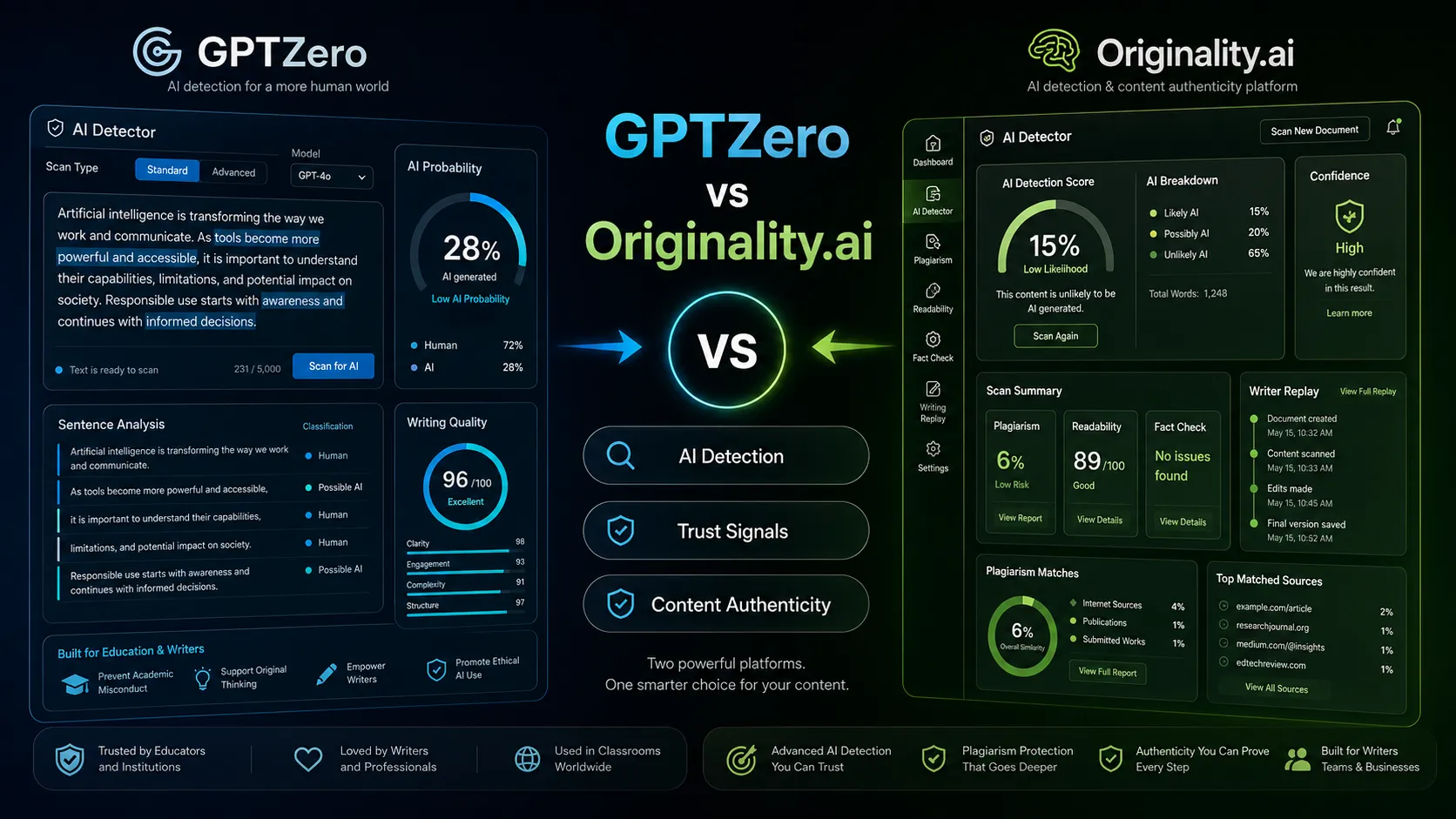
GPTZero vs Originality.ai is a useful comparison because both tools sit in the AI-detection conversation, but they do not solve the exact same buying problem. GPTZero is usually the easier first step when you want a detection-first check, writing review, Google Docs workflow, or a lighter classroom/editorial checkpoint. Originality.ai makes more sense when you are building a recurring publisher QA process around AI detection, plagiarism checks, readability, reports, WordPress, and team usage.
The mistake is asking only which detector is more accurate. The better question is whether you need a free-first AI review tool or a paid content integrity workflow your team will use repeatedly.
Quick verdict
Choose GPTZero if you want the easier first click: a free-first AI detection path, education-friendly review, writing replay context, Chrome or Google Docs workflow, and the option to move into team or API usage only after you prove the need.
Choose Originality.ai if your decision is closer to publisher QA: recurring AI and plagiarism checks, credit planning, shareable reports, WordPress workflow, API access, team management, and broader content quality checks before publishing.
Neither tool should be treated as final proof of authorship. Use the result as a review signal, then check plan limits, billing interval, refund language, and workflow fit before paying.
At-a-glance comparison
| Decision point | GPTZero | Originality.ai |
|---|
| Best for | Free-first detection, classroom review, writing feedback, and lighter editorial checks | Publisher QA, plagiarism checks, recurring content review, team reports, WordPress, and API workflow |
| Pricing style | Free entry plus paid dashboard, team, annual, and API paths; verify live checkout | Pay-as-you-go, Pro, and Enterprise credit-based paths; verify credit rules before paying |
| Free plan or trial | Free detector path exists; optional trial language should be checked at checkout | A limited free checker exists, but the main paid platform does not currently present a full free trial |
| Workflow strength | Easier to start, especially for teachers, students, writers, and reviewers | Stronger for repeated publishing, agency, SEO, and team QA processes |
| Team fit | Useful when you need seats, reports, Docs/Chrome workflow, LMS-style needs, or API | Stronger when team roles, scan history, shareable reports, WordPress, site checks, or API matter |
| Main risk | Non-refundable purchase language makes pre-purchase testing important | Credit expiry, credit usage, and discretionary refunds need careful review |
| Best next step | Start with /store/gptzero/, then read /review/gptzero-review/ if the workflow still feels unclear | Start with /store/originality-ai/, then read /review/originality-ai-review/ before choosing a credit path |
Choose GPTZero if…
GPTZero makes more sense if you want a lower-friction way to check whether AI detection belongs in your workflow at all. That matters for teachers, students, editors, hiring reviewers, and small teams who are not ready to build a full content QA system around every document.
The practical edge is the first-step experience. You can start with the free detection path, then decide whether paid features, team seats, Google Docs workflow, writing replay, or API access actually matter. That is safer than buying a heavy plan before you know how often you will check content.
GPTZero is also the better fit if the context around writing matters. A simple detector result can be too thin for academic or editorial use. GPTZero’s Chrome and Google Docs positioning makes it more relevant when the buyer wants review support inside the writing process, not just a copy-paste box after the fact.
You may not love GPTZero if you need a broader publisher stack. If your team also needs plagiarism checks, full-site review, WordPress integration, credit accounting, scan tagging, or a recurring editorial QA workflow, Originality.ai may feel more operationally complete. Also, GPTZero’s terms make checkout caution important: if a paid plan is non-refundable, the safer move is to test the free path and verify the selected plan, billing interval, seat count, and cancellation terms before paying.
If you are still evaluating GPTZero, read /review/gptzero-review/ before using /coupon/gptzero-coupon-code/. The discount step should come after workflow fit.
Choose Originality.ai if…
Originality.ai makes more sense when the problem is not one document. It is stronger when a publisher, agency, SEO team, or content manager needs a repeatable checkpoint before content goes live. In that context, AI detection is only one part of the decision. Plagiarism, readability, fact-checking, grammar, reports, WordPress workflow, API access, and team management can matter more than the fastest free check.
The biggest difference is operational depth. Originality.ai is built for people who scan content often enough that credit planning becomes part of the workflow. A solo writer may find that annoying. A content team may prefer it because credits, history, shareable reports, roles, and integrations make the review process more structured.
Originality.ai is also a stronger fit when you need a publisher-facing audit trail. If writers submit drafts, editors review them, managers need shareable results, and a site owner wants checks closer to WordPress or API workflow, Originality.ai gives more paths to build a process around the tool.
The tradeoff is that you should understand the credit model before paying. The public pricing page currently presents Pay as you go, Pro, and Enterprise paths, but buyers should still verify live pricing, word-to-credit rules, subscription credit expiry, top-up behavior, scan history, and the selected billing interval before checkout. Refunds are also described as discretionary, so do not treat the purchase as a no-risk trial.
If Originality.ai looks better, start with /store/originality-ai/ for plan context and use /review/originality-ai-review/ before choosing pay-as-you-go or subscription billing. Use /coupon/originality-ai-coupon-code/ only after the workflow and credit path make sense.
Avoid both if…
Avoid both tools if you want a detector to make a final judgment for you. AI detection can support review, but it should not replace context, writing history, policy, human judgment, or a clear editorial process.
Also avoid both if you have not defined the job yet. “I need to check AI text” can mean classroom review, student self-check, client proof, publisher QA, plagiarism screening, site-wide review, API integration, or team governance. Both tools help only after you know which workflow you are buying for.
A very light user may not need either paid path. If you only check a few short passages each month, start with free tools and compare results carefully. Paying too early can create a bigger problem than the detector solves.
Pricing and plan fit
GPTZero is usually easier to test first because the free entry path is part of the buying story. Paid value depends on whether you need more checks, team seats, annual billing, Google Docs or Chrome workflow, plagiarism or writing feedback features, or API integration. The public pricing page also presents annual savings and an API path, but buyers should verify the live calculator, selected plan, seat count, billing interval, and API subscription requirements before checkout.
Originality.ai is more of a usage-planning decision. The current public pricing page presents a Pay as you go path, a Pro subscription path, and an Enterprise path. It also explains credits, monthly renewal, credit expiry, and different credit use depending on what you check. That is useful, but it means the buyer must estimate monthly volume before comparing price labels. A cheaper-looking plan may not be cheaper if you repeatedly run AI and plagiarism checks together.
Here is the compact buyer checklist before paying:
- For GPTZero, verify the free path, selected plan, billing interval, seat count, optional trial visibility, cancellation language, non-refundable purchase language, and whether you need dashboard use or API access.
- For Originality.ai, verify the current credit rules, credit expiry, expected monthly word volume, whether AI-only or AI-plus-plagiarism checks change credit use, scan history, team seats, WordPress/API needs, and refund policy.
- For both, decide whether you are buying for occasional review, classroom use, publisher QA, or technical integration before looking at any coupon route.
The safest interpretation: GPTZero is easier to justify when you want to test before paying; Originality.ai is easier to justify when recurring review volume makes a structured QA workflow worth the credit planning.
Workflow fit
GPTZero fits a workflow where the reviewer wants to answer, “Does this text need closer human review?” That is why it works well for teachers, students, writers, and editors who need a quick checkpoint before taking action. The Google Docs and Chrome angle also matters because it can keep review closer to the writing process.
Originality.ai fits a workflow where the editor asks, “Can this content pass our publishing standard?” That is a different job. A publisher may need AI detection, plagiarism checking, readability, grammar, fact-checking, reports, scan history, and team roles in one process. In that environment, a free detector is less important than repeatability.
This is the pair-specific split: GPTZero is stronger for free-first detection and writing-process review; Originality.ai is stronger for paid publisher QA and operational content integrity. If you mix those jobs together, the comparison gets muddy.
Feature depth and practical limitations
GPTZero’s useful features are strongest when they improve the review context: detection, writing feedback, Google Docs support, Chrome workflow, writing replay, team use, and API access when verified for the plan you choose. The limitation is that it should not be treated as a one-click verdict. Results still need policy, context, and human review.
Originality.ai’s useful features are strongest when they build a QA layer: AI detection, plagiarism checks, readability, grammar, fact checking, content optimization, scan history, shareable reports, WordPress workflow, and API documentation. The limitation is complexity. The more features you activate, the more you need to understand credits, settings, user roles, and monthly usage.
For solo users, feature depth can become clutter. For teams, feature depth can become the reason to buy. That is the real comparison.
Team, business, or advanced use
GPTZero can make sense for teams that need classroom review, editorial screening, or developer integration, but the buyer should verify the current plan details before assuming a specific number of seats, LMS fit, or API capacity. It is best when the team wants detection and writing-process context without managing a full publisher QA stack.
Originality.ai may fit teams better when the workflow includes writers, editors, site owners, and managers. Team roles, reports, scan history, WordPress, API access, and full-site checks can matter when content moves through several people before publishing. Still, team fit depends on the selected plan, user roles, support expectations, and expected monthly scan volume.
If your organization needs formal academic enforcement, compliance review, or employment-sensitive decisions, do not buy either tool as a shortcut. Define the policy first, then choose the tool that supports that policy.
Coupon, deal, and next-step path
Do not start with the coupon page if you are still unsure which tool fits. First decide whether you need GPTZero’s free-first detection workflow or Originality.ai’s publisher QA workflow.
After that, use the store and coupon routes as verification steps:
- Use
/store/gptzero/ or /store/originality-ai/ to review plan fit, pricing context, and buyer cautions.
- Use
/review/gptzero-review/ or /review/originality-ai-review/ if you need deeper product context before paying.
- Use
/coupon/gptzero-coupon-code/ or /coupon/originality-ai-coupon-code/ only after the better product is clear and you are ready to verify the live checkout path.
Do not choose GPTZero or Originality.ai because a deal route exists. Discounts change. Workflow fit is the durable decision.
Final verdict
Choose GPTZero if you want a lighter, free-first AI detection workflow for teachers, students, writers, editors, or reviewers who need a practical check before moving into paid seats, Docs/Chrome workflow, or API access.
Choose Originality.ai if you need recurring publisher QA: AI detection plus plagiarism, readability, reports, WordPress, API, credit planning, team review, and a more structured content integrity process.
If you are still unsure, do not start with the discount. Start with the workflow fit. Test the lighter GPTZero path if your use case is occasional or education-centered. Choose Originality.ai only when the broader QA stack is likely to be used often enough to justify credit management and paid platform complexity.
FAQ
Is GPTZero or Originality.ai better for beginners?
GPTZero is usually easier for beginners because the first step is lighter and the free detection path is more obvious. Originality.ai can still work for beginners, but it asks the buyer to understand credits, scan types, and plan fit sooner.
Which one is better for publishers?
Originality.ai is usually the better fit for publishers because it goes beyond AI detection into plagiarism, readability, reports, WordPress, team usage, and API workflow. GPTZero can still help with editorial screening, but Originality.ai is closer to a recurring content QA system.
Which one is better for teachers or students?
GPTZero is usually the more natural first choice for classroom-style review, student self-checking, and writing-process context. Originality.ai may fit education or institutional needs when plagiarism checks, reports, Chrome workflow, or team review are more important than a simple first check.
Should I choose based on coupon availability?
No. Coupon or deal routes should only be used after you know which product fits. Choose GPTZero for free-first detection and writing review. Choose Originality.ai for publisher QA and recurring content integrity. Then verify the current checkout path.
What should I check before paying?
For GPTZero, check the free path, trial visibility, billing interval, seat count, API needs, and refund/cancellation language. For Originality.ai, check credits, expiry, monthly volume, scan types, WordPress/API needs, team seats, and discretionary refund wording.
No. Treat both tools as review support, not final proof. AI detection can flag risk and guide human review, but decisions about students, writers, employees, or clients should include context, policy, and a fair review process.